

High Quality Home Decor Online Shop: 2026 Guide
Table of Contents
- What Separates a High Quality Home Decor Online Shop From the Rest
- Why Curated Home Goods Beat Endless Aisles
- Budget vs. Investment Pieces: Where to Spend and Where to Save
- How to Style a Home With High Quality Pieces Room by Room
- Sustainability and Ethical Sourcing in Home Decor
- Caring for Your Pieces So They Last for Years
- Where to Start Building a Considered Space
- Frequently Asked Questions
Last Updated: September 16, 2026
What Separates a High Quality Home Decor Online Shop From the Rest
A high quality home decor online shop curates around material integrity, honest product descriptions, and pieces built to last years rather than one season. The difference rarely shows in a thumbnail, it shows two years later, when the finish still holds.
Materials, Craftsmanship, and the Details That Last
Material choice is the most reliable signal of how a piece will age. A handmade porcelain vase fired and finished with a subtle oval rim holds its shape and cleans up easily, while a mass-molded alternative often chips at the lip within a year. The American Society for Testing and Materials standards for ceramic ware give manufacturers clear benchmarks for durability, and shops that publish material specifics are usually confident in what they sell.
Why Curated Home Goods Beat Endless Aisles
Endless selection creates decision fatigue and hides quality. When a retailer carries thousands of SKUs, most items are sourced to hit a price point, not a standard. A curated home goods model flips that: fewer pieces, each chosen for a reason, making it easier to build a room that feels intentional rather than assembled.
Budget vs. Investment Pieces: Where to Spend and Where to Save
Spend on the pieces you touch and see daily; save on the ones that rotate. Lighting, seating, and wall art anchor a room for years, so they justify more budget. Seasonal accents, candles, and small decor can be refreshed often without guilt.

A practical split for most rooms:
| Category | Spend or Save | Why | Example Price Tier |
|---|---|---|---|
| Lighting and lamps | Spend | Daily use, anchors the room | $45-$70 |
| Wall art and canvas | Spend | Large visual footprint, long lifespan | $60-$70 |
| Vases and planters | Spend | Frequently handled, shows wear fast | $50-$65 |
| Candles and scents | Save | Consumable, replaced often | $10-$15 |
| Small figurines and accents | Save | Easy to rotate seasonally | $5-$15 |
| Diffusers and humidifiers | Mid | Functional, affects daily comfort | $35-$55 |
How to Style a Home With High Quality Pieces Room by Room
Styling a home with high quality pieces comes down to restraint and layering: pick one anchor per room, the largest or most visually dominant piece, then build texture and light around it. Most designers work in a consistent order: anchor, lighting, textiles, then small accents, because each layer responds to the one before it.
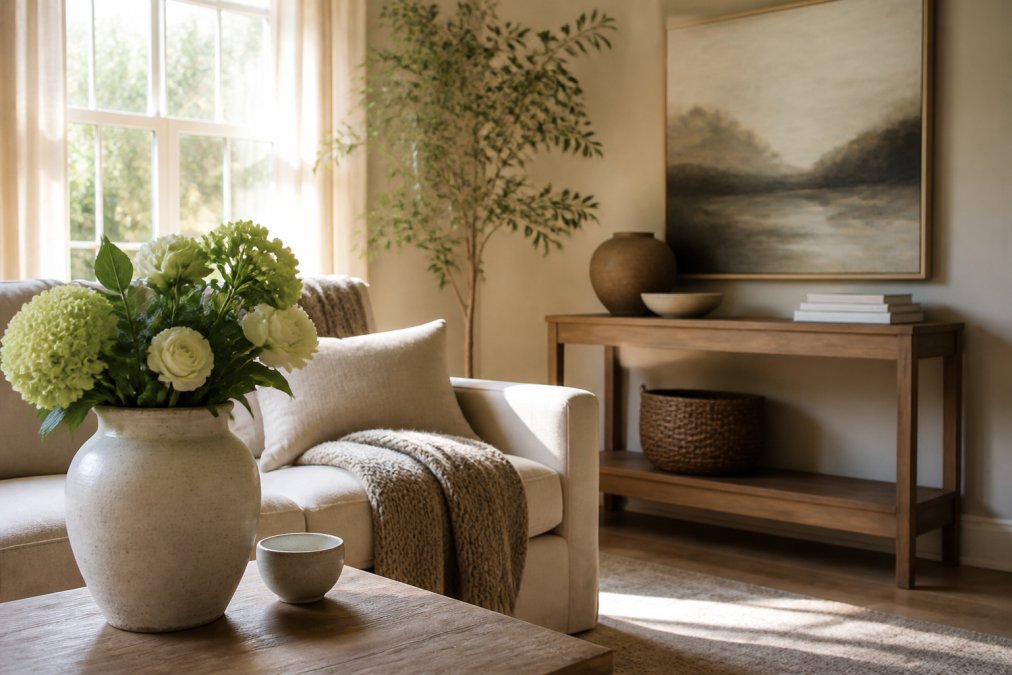
Living Room: Anchors, Lighting, and Wall Art
Start with wall art, because it sets the tone before anything else lands. A large canvas piece, like a monochrome tree study, gives the eye somewhere to rest and makes furniture arrangement easier. Then add a lamp for warm, layered light, and a vase or two for height and organic shape.
Three moves that work in almost any living room:
- Hang art so its center sits at eye level, roughly 57 to 60 inches from the floor
- Use one tall vase and one short vessel rather than matching pairs
- Place a lamp at the end of a sofa, not the center, to break up symmetry
Bedroom: Calm Textures and Soft Light
Bedrooms reward softness over statement. A low, warm light source does more than any single object: a crystal lamp on a nightstand gives a gentle glow bright enough to read by but soft enough to wind down with, and many people keep one on all night as a night light.
Entryway: The First Impression Room
Entryways are the most under-styled room in most homes and the easiest to fix. The anchor is usually a console table or bench, not art, because the entryway is a functional pass-through.
A simple entryway formula:
- One surface (console or bench) at roughly 30 to 34 inches high
- One vertical element, a mirror or tall vase, to draw the eye up
- One catch-all tray for keys and mail
- One soft element, such as a runner or a small stool with a cushion
Dining Room: Table, Light, and Centerpiece
Dining rooms are anchored by the table, and the second anchor is the light fixture above it. Hang a pendant or chandelier 30 to 36 inches above the table surface, sized at roughly one-third to one-half the table's width.
Kitchen: Functional Decor That Earns Its Space
Kitchens are the hardest room to decorate because every object competes with workspace, so decor must earn its footprint. A handmade porcelain vase on an open shelf, a wooden cutting board leaned against the backsplash, or a small ceramic bowl by the stove all serve a purpose and look intentional.
Luxury Home Staging Consultation Package →
A Note on Scale and Negative Space
Most styling mistakes are scale mistakes, not taste mistakes. A tiny vase on a large console looks lost; a large vase on a small side table looks crowded. Before buying, measure the surface and aim for the anchor to occupy roughly one-third of the available width. Leave the rest as negative space, it makes the anchor read as intentional rather than accidental.
Sustainability and Ethical Sourcing in Home Decor
Sustainability in home decor is less about labels and more about lifespan. A piece that lasts ten years uses far fewer resources than four replacements lasting two each, buying well is itself a form of environmental responsibility.
What to look for when vetting a shop's sourcing claims:
- Named materials rather than vague terms like "premium blend"
- Natural options where they make sense, such as soy wax over paraffin
- Repair or replacement guidance in the product listing
- Honest description of natural variation, especially in stone and wood
Caring for Your Pieces So They Last for Years
Care is where most decor quietly fails, and it's the easiest thing to get right. Dust with a dry, soft cloth, keep textiles out of direct sun, and follow each piece's instructions. A dishwasher-safe porcelain vase can be cleaned without worry, while resin figurines and crystal should be wiped by hand.
A simple maintenance rhythm:
| Piece Type | Cleaning | Frequency | Watch Out For |
|---|---|---|---|
| Porcelain and ceramic | Dishwasher or warm hand wash | As used | Chips at the rim |
| Resin figurines | Dry soft cloth | Monthly | Direct sunlight |
| Crystal lamps | Dry cloth, no water | Monthly | Dropping, hard surfaces |
| Canvas wall art | Dry duster | Monthly | Direct sun, humidity |
| Soy wax candles | Trim wick to 1/4 inch | Every burn | Tunneling, soot |
| Humidifiers | Rinse tank, dry fully | Weekly | Mineral buildup |
Material-Specific Care: Marble, Brass, Velvet, and Wood
The materials below reward a little extra knowledge, and are the ones most likely to be ruined by a generic cleaning product.
Two Habits That Prevent Most Damage
Two habits prevent most damage: trim candle wicks before every burn so wax melts evenly, and keep anything with a cord or USB connection away from standing water, unplugging before cleaning. That alone extends the life of most diffusers and lamps by years.
Where to Start Building a Considered Space
Quality is hard to judge from a photo, and most shoppers have been burned by a piece that looked better online than in the room. That gap between image and object is where most decor purchases go wrong.
Frequently Asked Questions
What should I look for when shopping for home decor online?
Check the materials list first. Porcelain, natural soy wax, and quality resin hold up better than generic plastic or paraffin. Look for specific dimensions (a vase listed at 2.5 x 2 x 8 inches tells you exactly what you're getting) and care instructions like dishwasher-safe. Reviews that mention longevity matter more than star averages. Finally, buy from shops that describe craftsmanship and sourcing, not just product photos.
How can you tell if home decor is high quality?
Weight, material, and finish are the quickest tells. Handmade porcelain feels denser than mass-market ceramic. Real soy wax burns cleaner and slower than paraffin. Resin sculptures with fine detailing hold their shape. Ask whether the piece is handcrafted or mass-produced, and check if the shop names its materials. A $60 handmade vase that lasts a decade costs less per year than a $15 vase you replace every season.
Is it worth buying high-end home decor online?
It depends on the piece. Investment items like lighting, wall art, and statement vases earn their price because you interact with them daily and they anchor a room for years. Budget-friendly accents like candles and figurines let you refresh seasonally without guilt. A balanced approach: spend on the pieces you see and touch most, save on the ones you rotate. Castellanos Housing carries both tiers, from $5 figurines to a $149 staging consultation.
Where can I find unique, curated home decor online?
Look for shops that edit rather than stock everything. A curated home goods selection means someone chose each piece for a reason, whether that's a specific aesthetic or a functional detail. Castellanos Housing, for example, carries handmade porcelain vases, crystal-infused soy candles, angel figurines, and ultrasonic diffusers, all chosen around an intentional living theme. Fewer, better options make it easier to find pieces that actually fit your space.
