

Curated Home Styling for Well-Being: A Guide
Table of Contents
- How Curated Home Styling Improves Well-Being
- The Psychological Impact of Your Home Environment
- Benefits of Intentional Home Design
- Decluttering vs. Curating: Understanding the Difference
- How to Curate a Home on a Budget
- Sustainable Home Decor for 2026: Building Intentional Spaces
- Sensory Design and Emotional Regulation
- Frequently Asked Questions
Last Updated: September 29, 2026
How Curated Home Styling Improves Well-Being
Curated home styling well-being is the intentional practice of selecting and arranging home decor and furnishings to create a space that reflects your values, supports your mental health, and enhances your daily life. At Castellanos Housing, we believe that the objects surrounding you aren't decorative afterthoughts, they're active participants in how you feel, think, and move through your home. When you approach your living space with intention rather than impulse, something shifts. The clutter dissolves. The noise quiets. And you notice that curated home styling improves well-being in ways both subtle and profound.
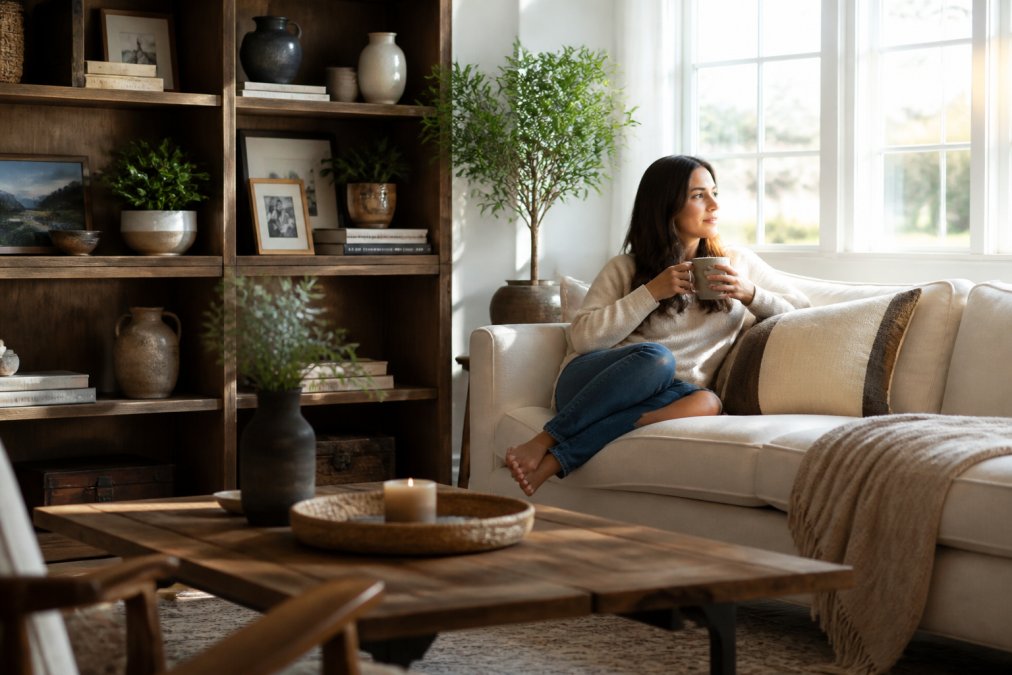
The relationship between your environment and your mental state isn't new science. Environmental psychology has long documented how physical spaces influence mood, stress levels, and cognitive function. But curated home styling improves well-being precisely because it goes beyond passive decoration, it demands that you make conscious choices about what enters your space and why. This intentionality is the difference between a room that happens to exist and a room that actively supports you.
The Psychological Impact of Your Home Environment
Your home environment shapes your emotional regulation, stress response, and sense of safety in ways you may not consciously register. When your space feels chaotic, your nervous system responds. When it feels intentional and cohesive, your body settles. Environmental psychology research consistently shows that overcrowded surfaces, mismatched aesthetics, and objects without meaning create low-level cognitive load, your brain is constantly processing visual information it doesn't need.
Conversely, spaces designed with intentionality reduce this load. A curated home creates what researchers call "spatial harmony", a visual and sensory environment that feels organized and coherent. This isn't about minimalism or perfection. It's about alignment. When every object in your space either serves a function you use daily or holds genuine meaning to you, your environment stops competing for your attention and starts supporting it.
The sensory experience matters enormously. Soft textures, natural materials, warm lighting, and the presence of nature (through plants, wood, stone) activate the parasympathetic nervous system, the part of your body that handles rest and recovery. Curated home styling improves well-being because it deliberately incorporates these elements rather than leaving them to chance.
Benefits of Intentional Home Design
The benefits of intentional home design extend far beyond aesthetics. When you curate your space, you're making a series of decisions that cascade through your daily life.
Mental clarity emerges when your visual environment is organized. Your brain has fewer distractions to process, which frees cognitive resources for actual thinking. People who live in intentionally designed spaces report improved focus and reduced decision fatigue, the mental exhaustion that comes from constant low-level choices about what to look at or navigate around.
Emotional regulation improves through thoughtful sensory design. Meaningful objects, photographs, inherited pieces, items that mark important moments, create what psychologists call "identity anchors." These objects remind you of your values, your history, and your place in the world. This grounding effect is measurable in how people describe their emotional state in curated versus chaotic spaces.
Stress reduction is perhaps the most immediate benefit. According to research on environmental stress, visual clutter triggers a stress response in the brain. Removing unnecessary items and creating a cohesive aesthetic directly lowers cortisol levels and reduces anxiety. Many people report sleeping better, feeling calmer, and experiencing fewer moments of overwhelm simply because their environment is no longer working against them.
A sense of agency and control emerges when you've deliberately chosen everything in your space. This is different from inheriting a decorated room or buying a matching set. When you curate, you're making active choices. That choice-making itself is psychologically restorative, it reinforces your sense of control over your environment and your life.
Decluttering vs. Curating: Understanding the Difference
These two concepts are often conflated, but they're fundamentally different practices with different outcomes. Understanding the distinction matters because it changes how you approach your space.
Decluttering is primarily about removal. You're eliminating excess, clearing surfaces, reducing volume. It's reactive, you're responding to chaos by taking things away. Decluttering creates space, which is valuable. But space alone doesn't create well-being. A minimalist room with bare walls and empty shelves is technically uncluttered, but it may not feel like home.
Curating, by contrast, is about intentional selection and arrangement. You're not just removing, you're choosing what stays because it serves you or speaks to you. You're then arranging those items with purpose. A curated space is sparse only where sparseness serves the design. It's full where fullness adds meaning. The difference is intention.
Crystal Manifestation Scented Candle →
Many people declutter, feel momentary relief, and then slowly fill the space again with the same patterns, because they never moved to the curation phase. Curating prevents this cycle. When you've decided that every object in your home is there for a reason, you become protective of that intentionality. New items face scrutiny. Spaces stay organized not through willpower but through clarity about what belongs.
How to Curate a Home on a Budget
The assumption that curated home styling requires significant spending is one of the biggest barriers to people adopting it. In reality, thoughtful curation often costs less than impulse purchasing because you're buying fewer, more intentional pieces.
Start with what you already own. Before spending anything, curate from your existing possessions. Gather items that genuinely reflect your aesthetic or hold meaning. Arrange them intentionally. You may discover that your space transforms significantly without adding a single new piece. This also clarifies your actual style preferences, which prevents costly mistakes later.
Invest in a few quality anchor pieces. Rather than filling your space with inexpensive items, choose 2-3 pieces that will anchor your aesthetic. These might be a quality lamp, a meaningful artwork, or a piece of furniture that genuinely suits your space. These anchors become the foundation that other, less expensive pieces can build around.
Source from secondhand and vintage markets. Some of the most beautiful curated homes are filled with pieces from thrift stores, estate sales, and online resale platforms. These items often have character and history that new mass-produced pieces lack. They're also typically far less expensive. The key is selectivity, you're still curating, just from a different source.
Use natural materials strategically. You don't need expensive wood furniture or imported stone. A few pieces incorporating natural materials, a wooden shelf, a stone coaster, plants in ceramic pots, create the sensory richness that makes a space feel curated. These elements are often inexpensive but disproportionately impactful.
Incorporate meaningful objects you already have. Photographs, inherited items, books, travel souvenirs, these are free or nearly free, and they're often the most powerful elements of a curated space.
| Strategy | Cost Level | Time Investment | Impact |
|---|---|---|---|
| Curate existing items | Minimal | 2-4 hours | High, immediate transformation |
| Add 2-3 anchor pieces | Moderate | 2-4 weeks | High, creates foundation |
| Source secondhand | Low | Ongoing | High, character and uniqueness |
| Incorporate natural materials | Low-Moderate | 1-2 weeks | High, sensory richness |
| Display meaningful objects | Minimal | 1-2 hours | Very High, emotional resonance |
Sustainable Home Decor for 2026: Building Intentional Spaces
Sustainable home decor for 2026 is increasingly inseparable from intentional curation. When you're selecting pieces with care, you naturally gravitate toward items built to last. This aligns perfectly with sustainability, the most sustainable item is the one you already own and love, followed by pieces designed for longevity.
Sensory Design and Emotional Regulation
Sensory design is the practice of intentionally engaging multiple senses, not just sight, to create an environment that supports well-being. Most people think of home design as visual only. But smell, touch, and even sound are equally powerful in shaping how you feel in your space.
Frequently Asked Questions
What does curated home decor actually mean?
Curated home decor means intentionally selecting and arranging items that reflect your values, aesthetic, and lifestyle rather than filling your space randomly. It involves choosing pieces with purpose, whether for function, beauty, or emotional meaning, and organizing them in a way that creates spatial harmony and supports your well-being. Curation emphasizes quality over quantity and builds a cohesive aesthetic that feels personal and considered.
How does curated home styling affect mental health?
Curated home styling reduces visual stress, promotes relaxation, and creates an environment that supports emotional regulation. A thoughtfully designed space decreases cognitive load, meaning your brain expends less energy processing visual clutter. This allows mental resources to focus on tasks, creativity, and well-being. Meaningful objects and intentional design choices also strengthen emotional connections to your home, making it feel like a true sanctuary rather than just a place to sleep.
Can I create a curated home on a limited budget?
Yes. Budget-conscious curation focuses on intentionality over spending. Start by decluttering what you have, then invest in a few quality pieces that align with your aesthetic and values. Look for sustainable home decor options that offer longevity, items like soy wax candles or crystal lamps that serve both function and beauty. Thrift stores, secondhand markets, and sales on timeless pieces allow you to build a curated collection without overspending. The key is choosing fewer items you genuinely love rather than accumulating more.
What's the difference between decluttering and curating a home?
Decluttering removes items you don't need or use; curating selects and arranges items intentionally. Decluttering is about subtraction and creating space. Curation is about thoughtful addition and arrangement. You can declutter without curating (leaving an empty, uninviting room), or curate without excessive decluttering (a full shelf of meaningful objects arranged beautifully). True well-being comes from combining both: removing what doesn't serve you, then filling your space with pieces that do.
