

Intentional Living Tips for Busy Adults
Table of Contents
- What Intentional Living Actually Means for Busy Adults
- Start With a Time Audit, Not a New Schedule
- Intentional Daily Routine Examples That Actually Fit Real Life
- Minimalist Home Environment Tips That Reduce Decision Fatigue
- Essential Oils for Stress Relief at Home
- Three Areas of Life Where Intentional Living Tips Pay Off Most
- Setting Core Values as Your Decision Filter
- Conclusion
Last Updated: August 23, 2026
What Intentional Living Actually Means for Busy Adults
Intentional living is making conscious choices that align with your core values, rather than defaulting to whatever habit or notification pulls at you next. It's not about doing less, it's about doing what actually matters to you, on purpose.
At Castellanos Housing, we believe in supporting a considered approach to daily living. Most intentional living advice assumes you already know your values and just need better systems. Most of us don't. We're running schedules built for someone else's priorities, in spaces never designed to support focus or rest.

The good news is that intentional living for busy adults doesn't require a retreat or radical overhaul. It requires honest questions and small, structural changes. According to the American Psychological Association's research on stress and decision-making, decision fatigue is one of the leading contributors to feeling overwhelmed, and simplifying daily choices is one of the most effective ways to recover mental clarity.
Start With a Time Audit, Not a New Schedule
The biggest mistake people make when trying to live more intentionally is reaching for a new planner before understanding where their current time actually goes. A time audit is different, it's a diagnostic, not a prescription.
How to Run a Simple Weekly Time Audit
Run your time audit for one full week before changing anything:
- Track every activity in 30-minute blocks in a notes app or spreadsheet
- Tag each block: energizing, draining, or neutral
- At week's end, total hours in each category
- Identify the top three time-consuming activities
- Ask: "If I removed this entirely, would my life feel worse?"
- Circle blocks misaligned with your stated priorities
The audit rarely shows what people expect. Many discover they spend more time on passive scrolling and reactive email than on anything purposeful. That gap between stated values and actual time allocation is where intentional living begins.
| Activity Category | What It Reveals | Next Step |
|---|---|---|
| Energizing blocks | Your natural strengths and values | Protect and expand these |
| Draining blocks | Misaligned obligations or habits | Audit for elimination or delegation |
| Neutral blocks | Necessary maintenance tasks | Batch or automate where possible |
| Reactive blocks | Interruption-driven time loss | Set boundaries and time blocks |
Saying No as a Practice, Not a Personality Trait
Saying no is a skill that gets easier with a clear decision filter. Pre-decide your criteria: if a commitment doesn't serve your top three priorities this season, the answer is no by default. You don't need to deliberate.
A simple script: "That sounds worthwhile, but I don't have the capacity to give it the attention it deserves right now." This is honest, kind, and complete.
Intentional Daily Routine Examples That Actually Fit Real Life
Intentional daily routines are not elaborate morning rituals. What works for busy adults is a short anchor sequence at each end of the day that creates a reliable transition between modes. The goal is orientation, not optimization.
A Morning Anchor Routine (15 Minutes or Less)
A morning anchor routine sets your mental direction before the day's demands take over:
- 2 minutes: Sit quietly before checking your phone
- 5 minutes: Write three things you intend to do today
- 5 minutes: Move your body, walk, stretch, or exercise
- 3 minutes: Review your top value or intention for the week
Consistency matters far more than content. A simple sequence done daily outperforms an elaborate one done occasionally.
An Evening Wind-Down Sequence for Mental Clarity
The evening sequence determines the quality of your sleep and the mental state you wake up in:
- Set a hard stop time for screens, ideally 45-60 minutes before bed
- Do a brief brain dump: write down anything unresolved from the day
- Prepare for tomorrow: lay out clothes, set your bag, review tomorrow's three intentions
- Create a sensory cue for sleep: this is where your environment does real work
The Castellanos Housing Adjustable Bamboo Cooling Pillow ($109) is designed for this transition. Its inner zipper lets you adjust the shredded gel-infused memory foam fill to fit your neck precisely, and the naturally cooling bamboo viscose cover supports quality sleep.

Minimalist Home Environment Tips That Reduce Decision Fatigue
A minimalist home environment removes the visual and physical noise that forces your brain to make low-stakes decisions all day. Every object in your line of sight is a micro-demand on your attention. Research from Princeton Neuroscience Institute's work on visual clutter and focus suggests that physical clutter actively competes for your attention and reduces your ability to focus.

Decluttering Physical and Emotional Space Together
Physical clutter and emotional clutter accumulate together. The pile of items you've been meaning to deal with is often connected to a decision you've been avoiding.
A practical framework:
- The one-year rule: If you haven't used it in 12 months and it has no sentimental value, it leaves
- One-in-one-out: Every new item displaces an existing one
- Designated homes: Every object has one assigned place; anything without a home is a candidate for removal
The Castellanos Housing Sculpted Bin ($38) maintains its modern silhouette in pantries, bedrooms, or living rooms, available in Carbon and Stone.
Sensory Details That Shape How a Room Feels
Lighting temperature, surface texture, ambient sound, and scent all shape how a space feels to inhabit. Swap overhead fluorescents for warm-toned lamps in the evening. Add texture through natural materials. Reduce hard surfaces that bounce sound. These small changes have a disproportionate effect on how supported the space feels.
Essential Oils for Stress Relief at Home
Scent is the only sense with a direct neural pathway to the limbic system, the part of the brain that regulates emotion and memory. This is why a familiar scent can shift your mood faster than almost any other environmental input.
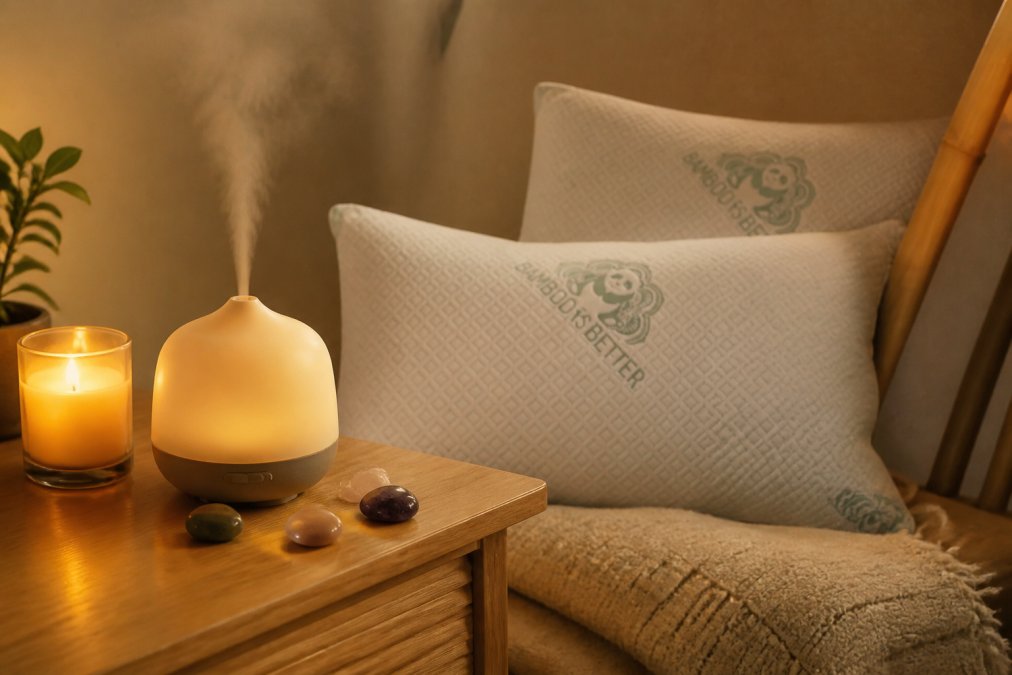
Use scent as a behavioral anchor. The same scent used consistently during your wind-down routine begins to signal "rest" to your nervous system. Lavender, cedarwood, and bergamot are commonly used for this purpose. According to the National Institutes of Health's review of aromatherapy and stress reduction, lavender has been studied for its effects on anxiety and sleep quality, with several trials showing measurable reductions in self-reported stress.
The Castellanos Housing Portable Ultrasonic Oil Diffuser ($19) offers dual-function design that also humidifies the air. For a desk or nightstand, the USB Mini Air Humidifier and Essential Oil Diffuser ($36) runs for up to 8-9 hours in intermittent mode and includes a soft LED night light.
Three Areas of Life Where Intentional Living Tips Pay Off Most
Intentional living tips generate the most return in three specific domains: how you spend money, how you protect attention at work, and how you relate to technology.
Financial Intentionality: Spending That Reflects Your Values
Financial intentionality is not about budgeting more aggressively. It's about auditing whether your spending actually reflects what you say you value. Run a "values-aligned spending audit": list your top five values, then review your last three months of bank statements and tag each discretionary purchase against those values.
Before any non-essential buy, a 48-hour pause is often enough to determine whether the desire is value-aligned or impulse-driven. This is precision, not restriction.
Workplace Intentionality: Protecting Focus in a Distracted Day
Workplace intentionality starts with time blocking: assigning specific blocks to specific types of work and treating those blocks with the same firmness as external meetings. Designate two or three times per day for checking messages rather than leaving notifications on continuously. Identify your peak cognitive hours and protect them for your most demanding work. End each workday with a written "shutdown ritual" that closes open loops and sets tomorrow's three intentions.
Digital Intentionality vs. Digital Minimalism
Digital intentionality is more nuanced than digital minimalism. Use the tools that genuinely serve your values, and remove the rest. For every app on your phone, ask whether it is a tool you use intentionally or a slot machine you check reflexively. The ones that fall into the second category are candidates for deletion.
Setting Core Values as Your Decision Filter
Core values function as a decision filter. Without them, every choice requires fresh deliberation. With them, most decisions resolve themselves against a consistent standard.
Identify your core values by looking backward at moments when you felt most alive, most proud, or most at peace, and identify what those moments had in common. Write them down as three to five short phrases: "Deep work over constant availability" is more useful as a filter than simply "focus."
Apply them directly to decisions: before committing to anything significant, ask whether it moves you toward or away from each value. A weekly five-minute review asking what felt aligned and what didn't is enough to course-correct before misalignment becomes a pattern.
The Abbreviated Guided Sketchbook ($20) offers 12 artist-inspired prompts that make self-reflection tactile and concrete, drawing from art techniques to prompt thinking that purely verbal journaling often misses.

The goal of intentional living is not a perfect life. It is a considered one, where your time, space, and energy are in genuine service of what matters most to you.
Building an intentional life is harder when your environment works against you. Castellanos Housing offers a curated selection of home goods designed to support a more considered approach to daily living, from bamboo bedding that makes quality sleep effortless to diffusers that anchor your wind-down routine. Every product is chosen for the specific way it supports the details that make everyday life feel truly supported. Continue shopping at Castellanos Housing and bring more intention to the spaces where you actually live.
Frequently Asked Questions
How can I start living more intentionally without adding more to my to-do list?
The most practical starting point is subtraction, not addition. Run a quick time audit at the end of one week and identify two or three recurring commitments that don't align with your core values. Remove or reduce those before adding anything new. Intentional living is less about doing more and more about making conscious choices with the time and energy you already have. One small boundary set consistently does more than a full self-improvement plan that never gets started.
What are some real examples of intentional living in a busy household?
Practical examples include: setting a phone-free window at dinner to protect family connection, doing a five-minute evening tidy so mornings start without visual clutter, or choosing one shared activity per week that everyone actually enjoys rather than filling the calendar by default. Financially, it looks like pausing before any non-essential purchase and asking whether it serves a stated value. These aren't dramatic changes, they're small, repeatable decisions that compound into a purpose-driven daily rhythm over time.
Do essential oils actually help with stress relief at home?
Research on aromatherapy suggests that certain scents, lavender, bergamot, and frankincense among them, can support relaxation by influencing the nervous system through the olfactory pathway. The effect is real but modest; essential oils work best as part of a broader wind-down routine rather than as a standalone fix. Pairing a diffuser with a consistent evening habit, like dimming lights or stepping away from screens, gives the scent a behavioral anchor that strengthens its calming effect over time.
What is the difference between digital minimalism and digital intentionality?
Digital minimalism means removing apps, platforms, or devices that don't serve a clear purpose, a subtraction strategy. Digital intentionality is broader: it means deciding in advance how, when, and why you engage with technology, even the tools you choose to keep. You can be digitally intentional and still use social media, as long as you've set a specific window for it and it aligns with a defined goal. Most busy adults benefit more from intentionality than from strict minimalism, which can feel unsustainable.
This article was written using GrandRanker