

The Boho Depot vs Curated Lifestyle Shops: 2026 Guide
Table of Contents
- The Boho Depot vs Curated Lifestyle Shops: A Quick Comparison
- Curation Philosophy: Mass Selection vs Hand-Picked Assortment
- Price-to-Value Transparency: What You're Actually Paying For
- Sustainable Home Decor for 2026: What Sets Curated Shops Apart
- Evaluating Quality in Lifestyle Products: Materials, Craftsmanship, and Longevity
- How to Style a Curated Home: Bohemian Living with Intention
- What Curated Lifestyle Shops Offer That Mass Retailers Don't
- Frequently Asked Questions
Last Updated: September 12, 2026
The Boho Depot vs Curated Lifestyle Shops: A Quick Comparison
The Boho Depot vs curated lifestyle shops comes down to one question: volume or intention? The Boho Depot wins on selection breadth and lower entry prices. Curated lifestyle shops win on product quality, sourcing transparency, and the feeling that someone chose each item for a reason. This guide from Castellanos Housing breaks down both models.
Mass-market boho retailers stock hundreds of SKUs, rotate them fast, and compete on price. Curated lifestyle shops carry fewer items, vet them harder, and charge more because the vetting costs something. Neither model is dishonest; they optimize for different outcomes.
| Factor | The Boho Depot | Curated Lifestyle Shops |
|---|---|---|
| Assortment size | Hundreds of SKUs | Dozens, hand-picked |
| Entry price | Lower | Higher |
| Sourcing transparency | Rarely disclosed | Often documented |
| Product lifespan | Varies widely | Tested for longevity |
| Curation philosophy | Trend-driven volume | Intentional, seasonal |
| Best for | Quick trend buys | Long-term home building |
Curation Philosophy: Mass Selection vs Hand-Picked Assortment
Curation philosophy is the biggest divider between these two retail models. The Boho Depot operates on breadth: more products, more categories, more chances something catches your eye. Curated lifestyle shops operate on depth: fewer products, each chosen to fit a specific aesthetic and quality bar.
That difference has a real cost. A mass-retail buyer can approve hundreds of items a season; a boutique curator might approve fifteen (nrf.com). The mass model spreads risk across volume; the curated model concentrates risk on every decision, which is why its rejection rate is so much higher.
What most shoppers miss is that curation is a filter, not a markup. When a shop rejects nine of ten products, the survivor carries the cost of that evaluation. You're paying for the nine rejections, not just the one item.
How a Curated Buyer Actually Evaluates an Item
Most shoppers picture curation as taste. In practice it's a sequence of gates, and an item must clear every one before earning shelf space:
- Material truth. Is the material named specifically, and can the maker document where it came from? "Stoneware" is a claim. "High-fired stoneware from a named studio" is a fact. Buyers who cannot get the second answer usually stop here.
- Construction check. Are seams tight, glazes even, hardware solid, and finishes consistent across a sample? A single flawed sample is treated as evidence of a flawed run, not bad luck.
- Use test. Does the item survive normal handling, a candle that burns evenly to the end, a vase that does not sweat, a textile that holds color after washing? Curators run these tests themselves rather than trusting a spec sheet.
- Aesthetic fit. Does the piece belong in the shop's existing assortment, or does it compete with something already stocked? A curated shop would rather carry one strong vase than three similar ones.
- Maker relationship. Can the shop reach the maker directly, and will the maker stand behind a defect? This is the gate mass retailers skip entirely.
An item that fails any gate is rejected, and rejection isn't free: someone paid for the sample, shipping, testing time, and the maker conversation. That cost is one reason a curated price sits above a mass-market price for a similar-looking object.
Why Mass Retailers and Curators Optimize for Different Numbers
A mass retailer's core metric is sell-through velocity: how fast a SKU moves relative to its shelf space. If an item stalls, it gets marked down and cleared, and the buyer moves on. The system tolerates a high failure rate because volume absorbs it.
A curator's core metric is closer to repeat purchase rate on the assortment as a whole. If a customer buys one piece and returns for a second, the curation worked; if they buy once and never return, no markdown can fix it. That's why curated shops keep items in stock for years rather than a season.
What This Means When You Are Standing in the Aisle
If you're buying a trend piece you expect to replace in a year, breadth wins. If you're buying something you intend to live with, the gate sequence above is what you're actually paying for.
Price-to-Value Transparency: What You're Actually Paying For
Price-to-value transparency means the shop tells you why something costs what it costs. Mass retailers rarely do; curated shops increasingly do, because their customers ask harder questions.
Take a hand-poured soy candle. At a mass retailer you're paying for wax, fragrance, a jar, shipping, and margin. At a curated shop you're paying for those inputs plus a longer burn test, a specific scent blend, and a smaller production run. The question is whether the extra dollars buy something you can feel.
A common mistake is assuming higher price equals higher quality. It doesn't, automatically. What higher price buys at a good curated shop is accountability: a named maker, a stated material, and a return policy that assumes the product should earn its place in your home.
Don't confuse "handmade" with "durable." Plenty of handmade goods are fragile. Ask specifically about materials and care instructions before you buy, or you'll end up with something beautiful that cracks in a month.
Sustainable Home Decor for 2026: What Sets Curated Shops Apart
Sustainable home decor for 2026 is less about a label and more about a paper trail. Curated shops lead here because smaller supply chains are easier to trace: a boutique buying from twelve makers can name all twelve, while a mass retailer sourcing from hundreds of factories usually cannot.
The practical markers are unglamorous: materials that don't off-gas, packaging that isn't plastic-wrapped, and products built to last past one season. Buyers now ask for these directly, and shops that answer clearly earn repeat business.
Ethical Sourcing and Artisan Goods
Ethical sourcing means the shop can tell you who made the product and under what conditions. For artisan goods, that usually means small workshops, fair pay, and production runs measured in hundreds rather than hundreds of thousands.
This is where the two models diverge most sharply. Mass retailers optimize for unit cost, pushing production toward the cheapest labor. Curated shops optimize for relationship, pushing production toward makers they can visit and verify. The curated version costs more at the register and less in the long run.
Federal Trade Commission guidance on green marketing claims sets the standard for how sustainability claims must be substantiated. When a shop says "eco-friendly," it should be able to back that up.
Evaluating Quality in Lifestyle Products: Materials, Craftsmanship, and Longevity
Evaluating quality in lifestyle products comes down to three tests you can run in under a minute. First, check the material spec: solid wood, porcelain, or resin, or veneer and plastic? Second, inspect the joinery or finish: tight seams, even glaze, solid hardware? Third, read the care instructions, a product built to last usually tells you how to keep it that way.
Mass-market decor often fails the first test. Curated shops tend to pass it because their buyers reject anything that doesn't.
Here's a quick checklist to run before you buy anything:
- Material is named specifically, not described as "premium" or "high-quality"
- Dimensions and weight are listed, so you know what you're getting
- Care instructions exist and are realistic
- The maker or brand is named
- Return policy is clear and not buried
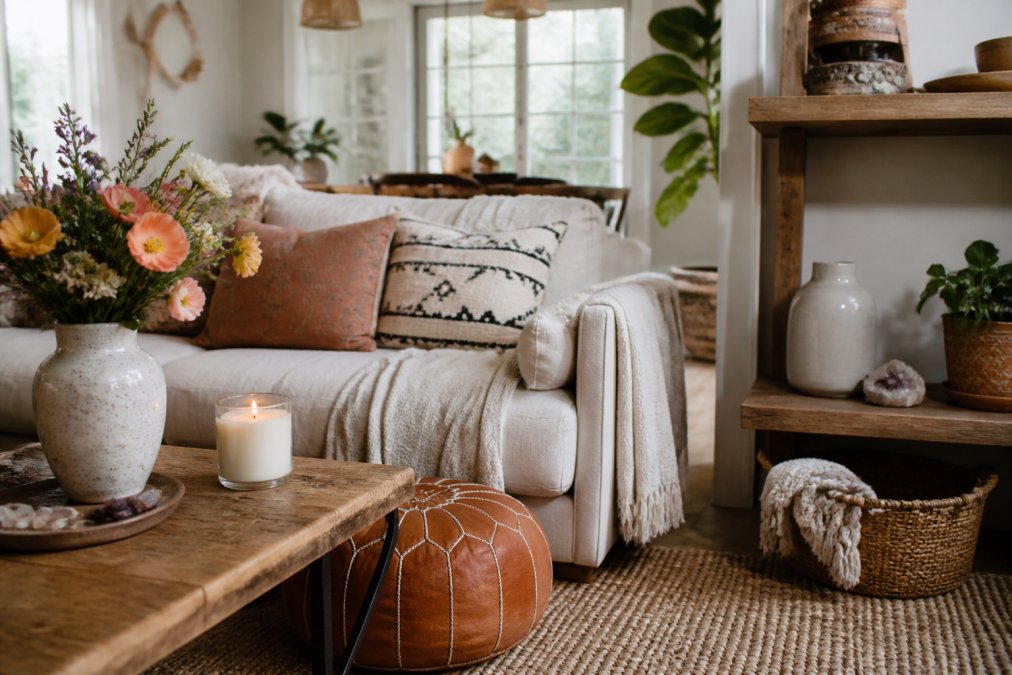
How to Style a Curated Home: Bohemian Living with Intention
Styling a curated home starts with subtraction, not addition. Most people over-decorate because they buy in volume; a curated approach means fewer pieces, each placed with a reason.
Start with one anchor object per room: a handmade vase, a sculptural candle holder, a single large textile. Build outward from there. Bohemian living works because it layers texture and light rather than filling space.
A Room-by-Room Method You Can Run in an Afternoon
The fastest way to see whether a room is over-decorated is to empty it visually: take everything off the surfaces, put it on the floor, and return only what earns its place. Most people put back about half. Then work through the room in this order:
- Anchor. Choose one object that sets the room's mood, a large vase, a woven wall hanging, a single statement lamp. It should be the biggest visual weight in the room and it should be the piece you would keep if you could keep only one.
- Ground. Add one textile that ties the seating area together: a wool throw, a jute rug, a linen cushion in a color pulled from the anchor. One, not three.
- Layer. Add two or three smaller objects that share a material with the anchor, wood with wood, brass with brass, matte ceramic with matte ceramic. Repetition of material is what makes a room read as intentional rather than assembled.
- Light. Add one light source at a height lower than eye level. Table lamps and floor lamps do more for a bohemian room than overhead fixtures, because they create pools of light instead of flattening the space.
- Scent. Add one scent source and stop. A single candle or diffuser per room is enough; competing scents cancel each other out.
Layering Textures, Scents, and Light
Layering means combining three or four materials that play off each other: porcelain against wood, linen against brass, matte against gloss. Add one scent source and one light source per room, and stop, more and the room starts fighting itself.
A useful rule of thumb is three textures per surface. A shelf with a ceramic vase, a wooden bowl, and a linen-bound book reads as styled; five ceramic objects read as a collection. Bohemian style tolerates more objects than minimalism but still rewards restraint in any single grouping.
This is where a curated shop earns its keep. Five pieces from one considered collection already work together; five pieces from five mass-market aisles take a weekend to cohere.
Styling an Outfit with the Same Logic
The same method works on a person. Start with one anchor garment, a printed skirt, a textured jacket, a hand-dyed top. Add a neutral base and one accessory repeating a color or material from the anchor. Stop. Bohemian dressing fails when every layer competes for attention.
Photograph the room or the outfit before you add anything else. The camera flattens a space and makes clutter obvious in a way your eye will not. If the photo looks busy, it is busy.
What Curated Lifestyle Shops Offer That Mass Retailers Don't
Curated lifestyle shops offer three things mass retailers structurally cannot: a point of view, accountability for what they stock, and service that assumes you'll come back. Mass retailers offer scale and price. Both are legitimate; they serve different shoppers.
The accountability piece matters most. When a boutique stocks an item, someone's name is attached to that decision, and when it sells poorly, the buyer hears about it. That short feedback loop forces better choices over time.
For shoppers who want a starting point, Castellanos Housing curates home and gift items around exactly this idea: pieces chosen because they make a space feel considered. The Luxury Home Staging Consultation Package at $149 is a good example of the model in practice, pairing a room-by-room plan with a curated decor list. If you'd rather start smaller, the Bloom Vase at $60 and the Crystal Manifestation Scented Candle starting at $12 both show the difference between a picked item and a stocked one.


Harvard Business Review analysis of customer experience and loyalty has documented how personalized service drives repeat purchasing in retail.
The challenge with buying home decor is that the cheap option rarely stays cheap. It gets replaced, re-bought, and eventually thrown out, and you end up spending more than if you'd bought well once. Castellanos Housing exists for the second path: a curated selection of home goods and lifestyle products built around intention rather than volume, from aromatic essential oils and diffusers to thoughtful gift pieces, each chosen for how it supports daily life. Browse the collection and find something that earns its place in your home.
Frequently Asked Questions
What defines a curated lifestyle shop compared to a traditional boutique?
A curated lifestyle shop selects products around a specific point of view, often prioritizing intentional living, artisan goods, and cohesive aesthetics. Traditional boutiques may carry a broader mix of trending items without a unifying theme. Curated shops typically offer fewer SKUs but deeper storytelling, better quality control, and a shopping experience designed to help you build a home that feels considered rather than cluttered.
Is the boho aesthetic still relevant for home decor in 2026?
Yes. The boho aesthetic has evolved toward intentional, sustainable home decor for 2026, with an emphasis on artisan goods, natural materials, and meaningful accents over mass-produced copies. Shoppers now look for hand-picked pieces that support self-expression and conscious consumerism rather than fast trends.
How do curated lifestyle shops ensure product quality and sustainability?
Curated shops often work directly with artisans or small-batch makers, which allows them to verify materials and production methods. When evaluating quality in lifestyle products, look for details like material composition (e.g., soy wax vs. paraffin), craftsmanship signals (handmade, small-batch), and transparent sourcing. These factors reduce the risk of items that look cheap in person or fall apart quickly.
What should I look for when choosing between local boutiques and curated online retailers?
Consider your priorities: local boutiques offer in-person browsing and immediate gratification, while curated online retailers provide broader access to artisan goods and detailed product information. For home accents, check return policies, material specs, and customer reviews. A hybrid approach works well: visit local shops for inspiration, then buy from curated online sources when you need specific items.
How can I tell if a lifestyle product is worth the higher price?
Price-to-value transparency comes down to materials, construction, and longevity. A $60 handmade porcelain vase that lasts decades may cost more upfront than a $15 mass-produced alternative, but the cost per year of use is lower. Ask: Is it handmade? What materials are used? Does the maker stand behind it? For consumables like candles, check burn time and wax type. These questions reveal whether you're paying for branding or genuine quality.
