

How to Choose Quality Home Decor: A 2026 Guide
Table of Contents
- Start with Your Space: Scale, Proportion, and Layout
- How to Identify Quality Furniture Materials
- Sustainable Home Decor for 2026: Sourcing and Longevity
- Tactile Sensory Testing: How a Piece Feels Matters
- How to Mix High and Low Decor for a Curated Look
- Building Your Color Palette and Visual Flow
- Conclusion
- Frequently Asked Questions
Last Updated: September 10, 2026
Start with Your Space: Scale, Proportion, and Layout
Learning how to choose quality home decor starts with measurement, not shopping. A beautifully made piece that overwhelms a room or floats awkwardly against a wall will never look right, no matter how much it cost. People often buy with their eyes online and discover the scale problem only after delivery.
Here is the throughline for this entire guide: quality is something you verify with a tape measure, your hands, and a flashlight, not something you trust from a product photo. Style is the easy part. Substance is where most buyers get it wrong.
Measuring for the Right Fit
Measure wall width, ceiling height, and the footprint of the space before you browse anything. For a sofa, leave at least 45 centimeters of walkway on its longest side. For wall art, a common guideline is that the piece should span roughly two-thirds to three-quarters of the furniture below it. Rug placement follows the same logic: front legs of seating should sit on the rug, not hover at its edge.
How to Identify Quality Furniture Materials
Material quality is the single biggest predictor of how a piece will age, and it is largely readable before you buy. Solid wood, kiln-dried hardwood frames, and joinery you can see (dovetails, mortise-and-tenon) all signal construction built to last. Particleboard with veneer can look identical in photos and fail within a few years under load.
The Heft Test: Weight, Finish, and Hardware
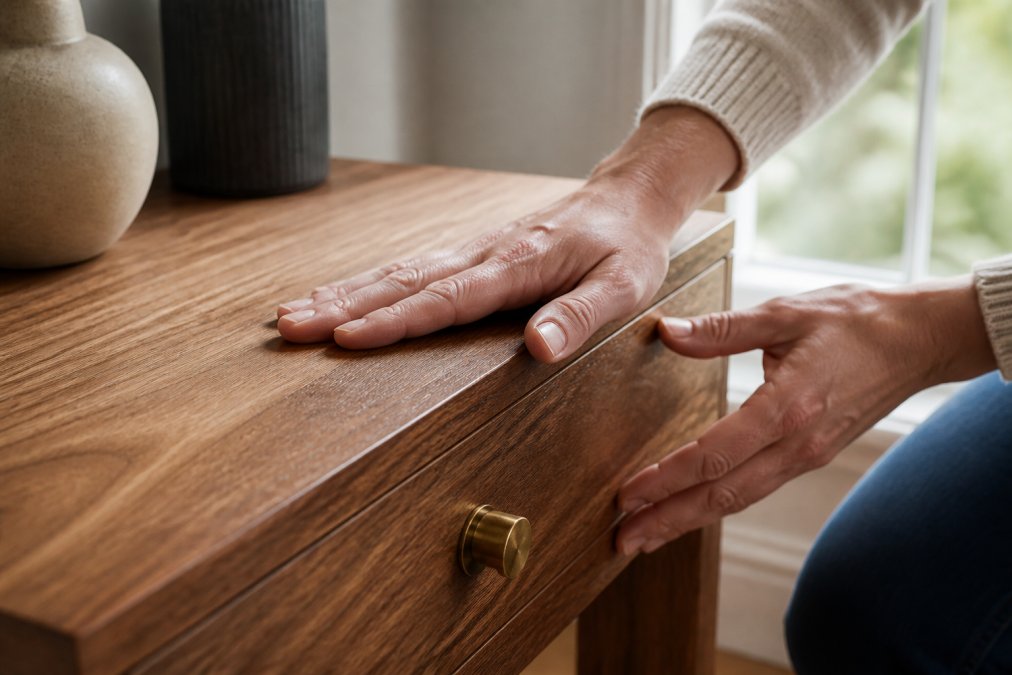
Pick the piece up, or check the shipping weight if you are buying online. Real wood and metal have heft; hollow composites feel light for their size. Run your fingers along the underside and back edges. A smooth, sealed finish on surfaces nobody sees tells you the maker cared about the whole piece, not just the front.
Hardware is the fastest tell of all. Brass hardware should feel dense and cool, with a weight that matches its size. Flimsy, hollow-feeling pulls and hinges that wobble under light pressure are the first things to fail. U.S. Consumer Product Safety Commission guidance on furniture stability also matters here: tip-over risk rises with tall, light cases, so check for wall-anchoring hardware on anything over waist height.
| What to Check | Quality Signal | Warning Sign |
|---|---|---|
| Frame material | Solid hardwood, visible joinery | Particleboard, staples, glue only |
| Weight | Heavy for its size | Light and hollow-feeling |
| Hardware | Dense brass, smooth action | Wobbly, hollow pulls |
| Finish | Sealed on hidden surfaces | Rough or unfinished undersides |
Sustainable Home Decor for 2026: Sourcing and Longevity
Sustainable home decor for 2026 is less about a label and more about lifespan. The most sustainable piece is the one you keep for fifteen years, not the one marketed as eco-friendly that you replace in two. That reframes the whole purchase: you are not buying a look, you are buying a maintenance schedule and a repair path.
Read the Material, Not the Badge
Start with what the piece is actually made of, because material choice drives both durability and end-of-life options:
- Solid wood over composites. Solid hardwood can be sanded and refinished multiple times over its life. Veneered particleboard cannot be refinished at all, once the veneer chips or lifts, the piece is done. Look for species names (oak, walnut, maple, ash) rather than the word 'wood.'
- Natural fibers over synthetics. Wool, cotton, linen, jute, and hemp wear and age differently than polyester blends. Wool resists soiling and holds shape; linen softens with washing; jute is strong but sensitive to moisture. Synthetic blends are often cheaper but pill, shed microfibers, and rarely biodegrade.
- Metals that patina rather than peel. Solid brass, bronze, and iron develop a surface patina and can be polished back. Plated or painted metals flake at edges and cannot be restored.
- Low- or no-VOC finishes. Finishes and adhesives are a common source of indoor volatile organic compounds. Water-based lacquers and hardwax oils cure with far less off-gassing than many solvent-based finishes, and hardwax oils can be spot-repaired instead of fully stripped.
Certifications Worth Knowing
Labels are only useful if you know what they verify. A few widely recognized ones in the furnishings and materials space:
- FSC (Forest Stewardship Council), chain-of-custody certification for wood and paper products.
- GREENGUARD Gold, limits on chemical emissions for products used indoors.
- Cradle to Cradle, scores material health, recyclability, and social fairness across tiers.
- Global Organic Textile Standard (GOTS), organic fiber and processing requirements for textiles.
- OEKO-TEX Standard 100, tests finished textiles for harmful substances.
None of these guarantee a piece will last. They tell you what went into it. Durability is still a construction question, which is why the material audit in the next section matters just as much.
Longevity Is the Real Sustainability Metric
A piece's environmental cost is spread across the years you keep it. A solid wood table refinished twice over twenty years beats three veneered tables sent to the curb. U.S. Environmental Protection Agency guidance on sustainable materials management frames this well: durability and repairability reduce waste far more effectively than chasing recyclable packaging.
To judge repairability before you buy, ask:
- Are replacement parts available? Cushion covers, hardware, and glides should be orderable years later.
- Can the finish be repaired locally? Hardwax oil and water-based lacquer can be spot-fixed; catalyzed factory finishes often cannot.
- Is the joinery mechanical or glued-only? Screwed, bolted, or knock-down joinery can be tightened and disassembled for repair or moving.
- Is the textile removable? Zippered, washable covers extend the life of seating dramatically.
Care as a Longevity Strategy
Quality materials reward maintenance, and neglect is what actually kills them:
- Solid wood: Dust with a dry or slightly damp cloth; avoid silicone polishes that build up. Re-oil or re-wax annually depending on finish. Keep out of direct sun and away from radiators to limit seasonal movement and fading.
- Brass and bronze: Let lacquered pieces stay lacquered; unlacquered pieces can be polished with a mild brass cleaner or left to patina. Avoid abrasive pads that scratch.
- Wool and natural textiles: Vacuum gently, rotate cushions to even wear, and clean spills promptly with a blotting motion rather than rubbing. Store clean and dry to prevent moth damage.
- Leather: Condition sparingly, keep away from direct heat, and wipe spills immediately, leather is forgiving but not waterproof.
A simple rule: if you cannot describe how you would clean and repair a piece, you have not finished evaluating it.
Tactile Sensory Testing: How a Piece Feels Matters
Touch is the sense online shopping removes, and it is the one that catches the most problems. Most guides stop at 'feel the weight.' A real tactile audit goes further: you are checking construction, not just surface. Here is how to run one.
The Three-Touch Check
Weight, temperature, and texture together form what I call the three-touch check. Touch the top surface, the edge, and the underside. If all three feel consistent, the piece was made with care. If the underside feels like a different product entirely, it probably is.
- Weight: Real wood and metal have heft for their size. Hollow composites feel light and often sound hollow when tapped.
- Temperature: Metal and stone feel cool to the touch and warm slowly; plastic and resin feel room-temperature immediately. This is a fast way to catch a faux finish.
- Texture: Run your palm across the surface. Feel for rough patches, uneven stain, or a finish that feels tacky. Tacky finish usually means it has not fully cured or was applied too thick.
Reading Construction by Hand
Once the surface passes, move to the joints and edges, where quality is decided:
- Joinery. Look for dovetails on drawer corners, mortise-and-tenon or doweled joints on frames, and corner blocks or brackets on case goods. Staples, glue-only butt joints, and screws driven straight into particleboard are the failure points.
- Drawer action. Pull a drawer out and push it back. It should glide without racking or wobbling. Wood-on-wood runners are traditional and repairable; cheap metal slides bend and lose alignment.
- Stitching and seams. On upholstery and textiles, check for tight, even stitching, matched pattern alignment across seams, and no loose threads or skipped stitches. Piping and welting should sit straight without puckering.
- Fill and support. Press a seat cushion: it should return to shape, not stay compressed. Check that the frame under upholstery is hardwood, not softwood or composite, by pressing along the front rail.
- Hardware. Brass hardware should feel dense and cool, with a weight that matches its size. Flimsy, hollow-feeling pulls and hinges that wobble under light pressure are the first things to fail.
The Flashlight Pass
Bring a small flashlight when shopping in person. Angling light across a surface reveals uneven finish, hairline cracks, and veneer seams that overhead lighting hides completely. Sweep it along:
- Edges and corners, where veneer lifts first.
- Drawer interiors and undersides, where makers cut corners.
- Joint lines, where gaps or filler show up under raking light.
Safety and Stability
U.S. Consumer Product Safety Commission guidance on furniture stability also matters here: tip-over risk rises with tall, light cases, so check for wall-anchoring hardware on anything over waist height. A heavy, well-built piece is more stable, but anchoring is still the right move for tall dressers, bookcases, and shelving, especially in homes with young children or pets.
What the Audit Tells You
A piece that passes the three-touch check, shows mechanical joinery, glides smoothly, and looks clean under raking light is very likely built to last. A piece that fails any one of those is a signal to slow down. You are not looking for perfection, you are looking for evidence that the maker thought about the parts you cannot see.
How to Mix High and Low Decor for a Curated Look
The trick to mixing high and low decor is anchoring each room with one or two investment pieces, then filling in with affordable accents. Spend on the things you touch daily and keep for years: seating, tables, lighting. Save on the things that rotate with the season: candles, vases, small art, textiles.
This is where a curated look beats a matching one. A room where every piece came from the same catalog reads flat. A room with one solid wood anchor and a mix of smaller finds reads collected, which is the whole point.
Building Your Color Palette and Visual Flow
A workable color palette starts with a neutral base covering roughly 60 percent of the room, one or two accent colors at about 30 percent, and a small hit of contrast at 10 percent. Visual flow comes from repeating one or two of those colors from room to room, so the eye carries through a doorway instead of stopping at it.
Neutral Base, Accent Colors, and Textural Contrast
Choose your neutral first, then pull accent colors from a piece you already love. Textural contrast does more work than color alone: pair a smooth porcelain vase with a rough linen runner, or a matte ceramic with polished metal. American Society of Interior Designers resources on color and spatial planning is a solid reference for how proportion and palette interact.
A handmade piece like the Bloom Vase earns its place here because the finish quality is visible up close, and it holds a single bouquet without competing with the room.

Conclusion
The hard part of choosing quality home decor is that the difference between good and cheap rarely shows in a photo. It shows in weight, finish, joinery, and how a piece feels under your hand. Castellanos Housing curates home goods with exactly that in mind: pieces chosen for how they support daily life, not just how they photograph. Our Angel Figurines & Decor Collection and Crystal Manifestation Scented Candle are made to be kept, not replaced. Continue shopping with Castellanos Housing and build a space that feels considered from the first piece.


Frequently Asked Questions
What are the hallmarks of high-quality home decor materials?
Look for solid wood rather than particleboard, natural fibers over synthetic blends, and metal hardware with real weight. Quality home decor typically uses materials that age well, like brass, stone, or kiln-dried hardwood. Check the finish quality too: smooth edges, consistent color, and no visible glue lines. A piece made from sustainable materials often carries a higher upfront cost but lasts years longer than cheaper alternatives.
How can you tell if a home decor item is well-made?
Pick it up. Heft and weight are strong indicators of material durability. Run your hand along the surface to feel for rough patches or uneven finishes. Check joints and seams, which should be tight and clean. Look at brass hardware for solid construction rather than hollow plating. For textiles, feel the weave density. These tactile checks reveal craftsmanship faster than any product photo or description.
How do you balance trendy decor with high-quality investment pieces?
Use the 80/20 rule: spend 80% of your budget on timeless anchor pieces like a solid wood console or a handmade porcelain vase, and 20% on trend-driven accents. This approach lets you refresh your space without replacing the foundation. When mixing high and low decor, put investment pieces where they get daily use, and let affordable accents handle seasonal or color-driven updates.
What are the benefits of choosing artisan-made home goods?
Artisan-made home goods often carry better craftsmanship, unique character, and more sustainable materials than mass-produced alternatives. A handmade porcelain vase or hand-poured soy candle reflects a level of detail that factory production rarely matches. These pieces also tend to hold up longer because the maker controls material selection and finish quality. You get a curated look that feels personal, not replicated.
How does material selection impact the longevity of home decor?
Material selection determines how a piece handles daily wear, moisture, and sunlight. Solid wood and natural stone resist warping and fading far better than veneers or plastics. Brass hardware develops a patina instead of peeling. Sustainable materials like soy wax and natural fibers also degrade more gracefully. Choosing the right material upfront means fewer replacements and less waste over time.
