

Why Do Cheap Diffusers Stop Working? Fixes That Help
Table of Contents
- The Real Reason Cheap Diffusers Stop Working
- Common Reasons Why Cheap Diffusers Stop Working
- How to Clean Ultrasonic Diffuser Components
- Essential Oil Diffuser Maintenance Tips to Prevent Failure
- Why Reed Diffusers Stop Throwing Scent (And What to Do)
- When to Repair vs. Replace Your Diffuser
- Choosing a Diffuser That Lasts
- Conclusion
- Frequently Asked Questions
Last Updated: September 9, 2026
The Real Reason Cheap Diffusers Stop Working
The difference between a $15 diffuser and a $50 diffuser is rarely the misting technology; it comes down to materials and quality control. Most inexpensive ultrasonic units use the same ceramic plate, but the plastic housing, motor bearings, and sensor components are where corners get cut.
A cheap diffuser is a small appliance with a motor, a heating element, and a circuit board, all operating near water. When a budget unit fails within a few months, the cause is almost always a preventable issue related to mineral buildup, sensor failure, or a cheap motor that burns out. Many fixes are simple and take less than ten minutes.
This guide covers the common failure points for inexpensive diffusers, how to fix them safely, and when it makes more sense to replace the unit rather than repair it. We also explain why reed diffusers, which have no moving parts, stop throwing scent and what you can do about it.
Common Reasons Why Cheap Diffusers Stop Working
Most cheap diffusers fail for one of three reasons: mineral buildup on the ultrasonic disc, a sensor that thinks the water level is wrong, or an airflow problem that causes the unit to overheat. Understanding which one you are dealing with is the first step to a fix.
If the unit turns on but produces little or no mist, the problem is usually the ultrasonic disc. If the indicator light comes on but the unit shuts off after a few seconds, you are likely looking at a sensor issue. If the unit runs for a while and then stops, check the ventilation. Each has a different solution.
The Ultrasonic Disc vs. The Fan Motor: Two Different Failures
A common misconception is that a diffuser that stops misting has a broken "motor." In reality, there are two separate mechanical components that can fail, and they produce different symptoms.
The ultrasonic disc is a ceramic plate that vibrates at approximately 1.7 million times per second to break water into a fine mist (PubMed). In budget diffusers, this disc is often thinner and less precisely manufactured. Over time, mineral scale from tap water can physically dull the disc's surface, reducing its vibration efficiency, a gradual failure noticeable over several weeks.
The fan motor pushes the mist out of the nozzle. In cheap diffusers, this is typically a small DC motor with bronze or plastic bushings instead of sealed ball bearings, which wear down quickly if run for hours. When the fan motor fails, the diffuser still lights up and the disc vibrates, but no mist escapes, a sudden failure, not a gradual one.
To tell which component has failed, place your hand near the mist outlet. If you feel no airflow but hear a faint buzzing from the base, the fan motor has likely burned out. If you feel airflow but see no mist, the ultrasonic disc is the problem.
Why Cheap Plastic Degrades Faster Than You Think
The housing material matters more than most guides acknowledge. Many budget diffusers use ABS plastic, which is not resistant to essential oils. Citrus oils contain d-limonene, a solvent that can cause ABS plastic to craze, crack, and become brittle over time, leading to hairline cracks around the mist outlet after a few months (pubchem.ncbi.nlm.nih.gov).
Higher-end units use polypropylene or Tritan plastic, which are more resistant to oil degradation; some premium models use inert glass or ceramic tanks. A cracked cheap plastic tank can leak water into the base, shorting the circuit board and creating an electrical hazard.
Sensor Failure: The Safety Feature That Becomes the Problem
The automatic shut-off sensor in a budget diffuser is often a simple float switch or a pair of metal probes that detect water conductivity. Cheap sensors are prone to two specific failure modes:
-
Mineral coating: Hard water deposits can coat the sensor probes, insulating them from the water. The sensor then reads "empty" even when the tank is full, causing the unit to shut off immediately. This is the most common sensor issue and is easily fixed with a rubbing alcohol wipe.
-
Float switch sticking: Some budget units use a small float that rises with the water level. If the float mechanism gets clogged with dried oil residue, it can stick in the "down" position, triggering the shut-off. This requires disassembling the tank to clean, which is often not worth the effort on a $15 unit.
The Water Quality Factor: Hard Water Is the Silent Killer
Tap water quality varies significantly across the United States. In regions with hard water, such as parts of the Midwest or Southwest where hardness can exceed 180 mg/L of calcium carbonate, minerals form a crusty scale on the ultrasonic disc that is harder to remove than the soft film from distilled water (usgs.gov). In extreme cases, this scale can physically etch the ceramic disc, permanently reducing output.
A high-end diffuser with a thicker, better-sealed ceramic disc can withstand years of hard water use with regular cleaning. A cheap disc, only a fraction of a millimeter thick, can be rendered useless in months. Using distilled water is the single most important factor in extending the life of a budget diffuser.
How to Clean Ultrasonic Diffuser Components
A thorough cleaning every few weeks prevents most failures. You will need white vinegar, distilled water, and cotton swabs. Never submerge the base of the unit in water, as this will damage the electrical components.
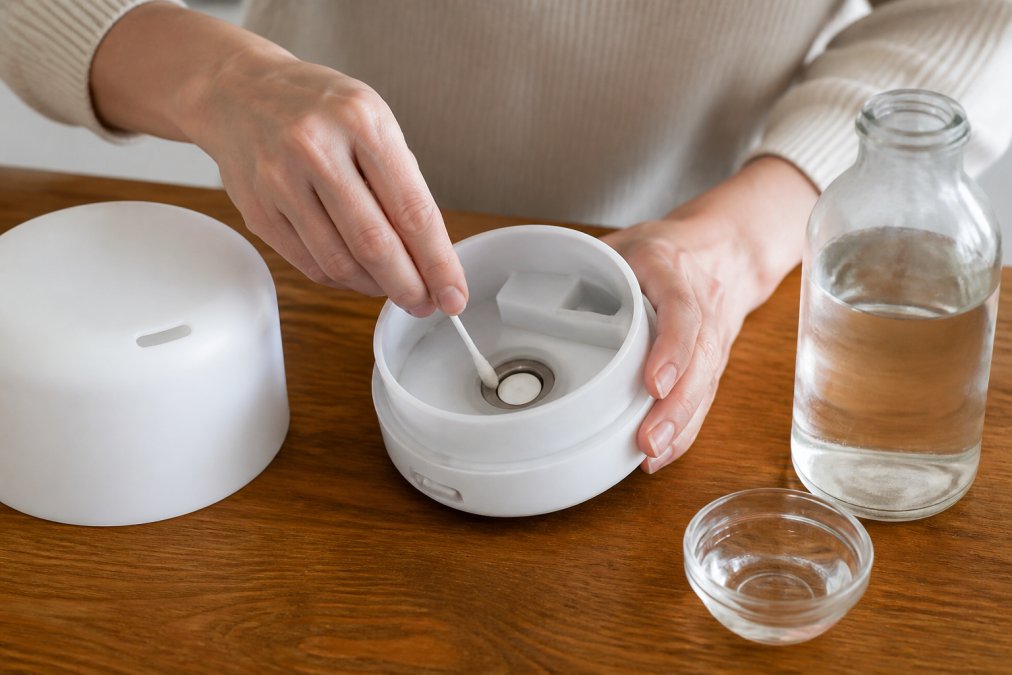
Follow these steps to clean the internal components safely:
- Unplug the unit and remove the top water tank from the base.
- Empty any remaining water and rinse the tank with clean water.
- Add a descaling solution of one part white vinegar to three parts water to the tank. Let it sit for 5 to 10 minutes to loosen mineral scale.
- Wipe the ultrasonic disc on the base with a damp cotton swab. Do not use abrasive scrubbers.
- Clean the sensor pins with a cotton swab dipped in rubbing alcohol to remove oil residue.
- Check the mist outlet and vents for dust or dried oil, clearing them with a dry swab.
- Rinse the tank thoroughly and refill with distilled water before running the unit again.
For a quick weekly wipe-down, use a soft cloth to remove dust from the exterior and the mist outlet. This prevents buildup from becoming a problem in the first place.
Essential Oil Diffuser Maintenance Tips to Prevent Failure
Consistent maintenance is the single most effective way to extend the life of a cheap diffuser. The goal is to prevent buildup before it starts, rather than fixing it after the unit fails.
- Use distilled water. Tap water introduces minerals that cause scale on the disc. Distilled water, which costs about a dollar a gallon, eliminates this issue entirely.
- Clean after every 3 to 4 uses. Do not let oil residue sit and dry inside the tank.
- Do not overfill. Adding water past the maximum line can cause the unit to malfunction and may damage the sensor.
- Run the unit dry occasionally. Running a diffuser until it shuts off automatically helps clear the lines and prevents stale water from sitting in the reservoir.
- Store it empty. If you are not using the diffuser for a while, empty it completely and let it dry to prevent mold and mineral deposits.
Why Reed Diffusers Stop Throwing Scent (And What to Do)
If you have switched to a reed diffuser to avoid the maintenance of an ultrasonic unit, you may have noticed that the scent fades over time. This is not a mechanical failure, because reed diffusers have no motor or heating element. The issue is the evaporation rate.
Reed diffusers work through capillary action: oil travels up the porous reeds and evaporates into the air. Over time, the reeds become saturated with oil that has lost its volatile fragrance compounds, leaving a heavier base that does not throw scent as effectively.
Flip the reeds every week or two to expose the dry ends to the oil. When the oil level drops to about a quarter of the bottle, the scent will weaken; at that point, replace the reeds or the entire diffuser. Reed diffusers are low-maintenance but do not last forever, evaporation depends on room temperature, airflow, and oil quality.
When to Repair vs. Replace Your Diffuser
Not every broken diffuser is worth fixing. The decision comes down to the cost of the unit, the nature of the problem, and, most importantly, your safety. A diffuser combines electricity with water, so the risk of an electrical short or fire is real, especially in budget units with thinner wiring.
| Problem | Likely Fix | Repair Cost | Worth It? |
|---|---|---|---|
| Mineral buildup on disc | Vinegar descaling | $1 | Yes |
| Clogged mist outlet | Cotton swab cleaning | $1 | Yes |
| Faulty water level sensor | Sensor replacement | $10-$15 | Only if unit is expensive |
| Burnt-out fan motor | Motor replacement | $15+ | No, replace the unit |
| Cracked water tank | Tank replacement | $10+ | No, replace the unit |
If a simple cleaning does not restore function, the problem is likely a faulty sensor or burnt-out motor. For a diffuser that cost under $20, the repair cost rarely justifies the effort; a new unit with better materials is the smarter investment.
For a diffuser in the $30 to $50 range, a sensor replacement might be worth considering if you can source the part, but confirm the cost first, a replacement sensor plus shipping can easily approach the price of a new unit.
The Safety Red Line: When a Diffuser Is Unfixable
There is a clear line between a diffuser that can be safely repaired and one that should be unplugged and discarded immediately. If you encounter any of the following, do not attempt a repair:
- Water in the base or around the circuit board: If you see signs of moisture inside the base unit, fogging under the control panel, corrosion on the metal contacts, or water pooling around the power jack, the unit is compromised. Even if it dries out and works again, the internal corrosion will continue and can lead to a short circuit.
- Burning smell or discoloration: A burnt plastic or electrical smell, or any yellowing or browning around the power adapter port, indicates overheating. This is a fire hazard.
- Cracked or warped housing: A crack in the base that exposes the circuit board or wiring is an electrical shock risk, especially if you have children or pets.
- The power adapter gets hot to the touch: A warm adapter is normal, but one that is too hot to hold for more than a few seconds is failing and can start a fire.
DIY Repair: What Is Actually Safe to Attempt
For the average user, there are exactly two safe repairs: cleaning the ultrasonic disc and cleaning the sensor pins, both done from outside the unit. Anything beyond that, replacing a fan motor, resoldering a connection, or swapping a circuit board, requires opening the base, which voids the warranty and exposes you to live electrical components.
If you are handy with a soldering iron, a fan motor replacement is technically possible. A replacement DC fan motor costs around $5 to $10, but it must match the voltage and current draw of the original; a mismatched motor can overload the circuit board or overheat. Unless you have experience with small electronics, this is not recommended.
The Hidden Cost of Repairing a Cheap Diffuser
Beyond the part cost, consider the value of your time. A thorough cleaning takes 10 minutes; a sensor replacement might take 30 minutes plus sourcing and shipping time. When you factor in the risk of the repair not working or causing a safety issue, the math rarely favors repairing a unit that cost less than $25.
Treat a cheap diffuser as a disposable appliance with a lifespan of 6 to 12 months with proper maintenance. When it fails beyond a simple cleaning, recycle it if your local program accepts small electronics, and replace it with a unit that has better materials and a sealed fan motor. The upfront cost is higher, but the total cost of ownership over two years is often lower than repeatedly buying $15 diffusers.

Choosing a Diffuser That Lasts
The best way to deal with a cheap diffuser that stops working is to not buy one in the first place. That does not mean you need to spend a fortune. It means paying attention to a few key specifications and materials.
Look for a unit with a ceramic or glass water tank instead of a thin plastic one, which is prone to cracking and can absorb oil odors. Check the motor's wattage, a slightly higher wattage generally means a stronger motor that can handle continuous use. Also consider the brand's warranty and customer support, as a company that stands behind its product signals quality.
Our selection at Castellanos Housing focuses on details that make everyday life feel considered. The diffusers we carry are chosen for their build quality and design, not just their price point. For example, the Portable Ultrasonic Oil Diffuser and Air Humidifier is a versatile option that doubles as a humidifier, and the New USB Portable Mini Air Humidifier includes an automatic shut-off feature that protects the motor from running dry. Investing in a well-made unit from the start is cheaper than replacing a budget diffuser every few months.

Conclusion
Cheap diffusers fail for predictable reasons: mineral scale on the ultrasonic disc, faulty water level sensors, and blocked airflow. Most issues are preventable with simple maintenance using distilled water and routine cleaning.
When a unit does fail beyond a simple fix, resist the urge to repair a $15 appliance. The time and parts cost more than a replacement. Instead, invest in a diffuser built with better materials and a reliable motor.
At Castellanos Housing, we curate products designed to support a calm, intentional home. Browse our collection of diffusers and essential oils to find a piece that lasts, and continue shopping for a space that feels both beautiful and deeply felt.
Frequently Asked Questions
Why does my diffuser turn off automatically after a few minutes?
Most cheap diffusers have an automatic shut-off sensor that activates when the water level gets too low. If your diffuser stops after a few minutes with a full tank, the sensor is likely blocked by mineral buildup or essential oil residue. Clean the sensor and the water reservoir with a vinegar solution, then rinse thoroughly. If the problem persists, the sensor itself may be faulty, which is a common failure in budget models.
How can I troubleshoot a diffuser that isn't producing mist?
First, check the power adapter and the electrical connection to ensure the unit is receiving power. Next, unplug the device and inspect the ultrasonic disc on the bottom of the water reservoir. A white crust of mineral buildup there will stop mist output. Clean it gently with a cotton swab dipped in vinegar. Also, make sure the water level is within the marked range and that the mist outlet on top is not clogged.
What is the typical lifespan of an essential oil diffuser?
A well-maintained diffuser can last for several years, but cheap diffusers often fail within six to twelve months. The primary reason is that budget models use less durable components, particularly the ultrasonic disc and the internal fan. Regular cleaning prevents mineral buildup, which is the main cause of premature failure. If you use hard tap water, consider using distilled water to extend the life of the device.
Is it possible to reset an essential oil diffuser?
Many diffusers can be reset by unplugging them and leaving them off for at least 30 minutes. This allows the internal circuits to discharge fully. Before resetting, empty the water reservoir and clean the device. After plugging it back in, add fresh water and try again. If the indicator light does not turn on after a reset, the power adapter or the internal electrical connection is likely damaged, which is often not worth repairing on a budget unit.
