

Signs of Well Made Home Accessories: A 2026 Guide
Table of Contents
- Why Quality in Home Accessories Matters More Than Ever
- Material Integrity: The First Sign of a Well Made Accessory
- How to Identify Quality Home Decor Through Construction
- Signs of Artisan Craftsmanship vs. Mass Production
- Sustainable Home Decor for 2026: Materials That Last
- The Sensory Test: Tactile Checks for Longevity
- Common Mistakes to Avoid When Shopping for Decor
- Build a Collection That Lasts: Final Thoughts
- Frequently Asked Questions
Last Updated: September 8, 2026
Why Quality in Home Accessories Matters More Than Ever
The difference between a home that feels curated and one that feels cluttered often comes down to the quality of its accessories. When you understand the signs of well made home accessories, you stop wasting money on pieces that look cheap in person or fall apart within months. This guide from Castellanos Housing walks through the physical markers of durability, from material integrity to joinery, so you can shop with confidence.
Many shoppers default to price as their only quality signal, but cost alone rarely predicts longevity. A heavier vase or a tightly woven textile tells you more about construction than a brand name ever will. Learning to read these physical cues transforms how you evaluate everything from candle holders to storage bins.
Below, we’ll show you exactly how to inspect material composition, test hardware, and spot the difference between artisan craftsmanship and mass production. These evaluation strategies can help build collections that last for decades rather than seasons.
Material Integrity: The First Sign of a Well Made Accessory
Material integrity is the foundation of any well made home accessory, determined by the density, origin, and composition of its primary materials. A porcelain vase that feels substantial in hand, rather than hollow and thin, signals higher-quality clay and proper firing. Similarly, textiles woven from long-staple fibers resist pilling and maintain their shape far longer than their short-staple counterparts.
Sustainable home decor for 2026 leans heavily on materials that age gracefully. Look for organic cotton, linen, wool, and stoneware, all of which develop character through use rather than degrading quickly. The Sedona Australian Cotton Waffle Towels from our collection exemplify this principle, using 100% Australian cotton in an open weave that becomes softer with each wash while remaining highly absorbent.

How to Identify Quality Home Decor Through Construction
Construction quality reveals itself through weight distribution, surface treatment, and how components connect. When learning how to identify quality home decor, start by holding the piece and noticing where the weight concentrates.
Weight, Balance, and Finish Consistency
A well balanced accessory sits evenly on flat surfaces without wobbling. Pick up the item and feel whether the weight is distributed sensibly, with thicker material at the base for stability. The Bloom Vase, a handmade porcelain piece standing 8 inches tall, demonstrates this with a subtle oval rim and a base that anchors it firmly on any table.

Finish consistency matters equally. Examine surfaces under direct light for uniform glaze application, absence of bubbles, and smooth transitions between colors. Hand-applied finishes often show slight variations, which indicate human craftsmanship, but they should never show drips, bare spots, or rough patches.
Joinery and Hardware: Where Things Fall Apart
The fastest way to spot a well made home accessory is to inspect how its parts connect. For furniture and decor with moving components, check that joints fit flush without gaps or visible adhesive. Screws should sit flush with surfaces, and hinges should operate smoothly without resistance.
Hardware quality is a reliable differentiator. Solid brass, stainless steel, and zinc alloys resist corrosion and maintain their finish, while plated metals chip and tarnish quickly. When examining the Angel Candlestick Holder, notice whether the candle fits snugly without forcing and whether the piece feels stable when the candle is lit.
Signs of Artisan Craftsmanship vs. Mass Production
Artisan-made pieces carry subtle irregularities that mass production eliminates. Understanding the signs of artisan craftsmanship means learning to appreciate these variations as markers of human hands rather than flaws.
Mass-produced accessories often show identical, machine-perfect symmetry, uniform surface textures, and hollow construction designed to minimize material costs. Artisan pieces, by contrast, may show slight variations in glaze depth, hand-thrown asymmetry, or visible tool marks that tell the story of their creation.
The Sculpted Bin exemplifies thoughtful production: its structured shape maintains form while the durable construction handles daily use. Mass-produced bins often collapse under weight or lose their shape within months, whereas well-constructed storage maintains its silhouette over years of service.

Sustainable Home Decor for 2026: Materials That Last
Sustainability claims are easy to print on a hang tag, but the physical evidence of a material's environmental story is written in its fiber length, firing temperature, and finishing chemistry. To predict whether a piece will still be in use five or ten years from now, you need to inspect those markers directly.
Fiber Length and Spinning Method
The single most reliable predictor of textile longevity is staple length. Long-staple cotton (typically 1.25 inches or longer) spins into smoother, stronger yarns that resist pilling and fibrillation. Short-staple cotton, common in fast-fashion and promotional-grade goods, produces fuzzy, weak yarns that shed lint and break down within a few dozen wash cycles. Run your thumb and forefinger along the yarn direction of any woven textile. A smooth, continuous surface indicates long-staple fiber; a hairy or fuzzy surface suggests short-staple content.
Weave density matters equally. A percale sheet with a 200 thread count woven from long-staple cotton will outlast a 600 thread count made from short-staple fiber because the yarn strength, not the thread count, determines abrasion resistance. For towels, look at the loop pile: densely packed, uniform loops retain absorbency, while sparse loops collapse and mat after repeated use.
Firing Temperature and Clay Body
Ceramic durability is a function of vitrification, the point at which clay particles fuse into a glass-like structure. Stoneware and porcelain fired above 2,200°F become nearly non-porous, resisting water absorption, staining, and thermal shock (ceramics.org). Earthenware, fired between 1,800°F and 2,100°F, remains porous unless sealed with a food-safe glaze. To test vitrification at home, hold the piece under a faucet for ten seconds, dry the exterior, and set it on a paper towel. If moisture weeps through, the clay body is under-fired and will absorb oils, harbor bacteria, and crack in freeze-thaw cycles.
Finish Chemistry and UV Stability
Natural finishes, tung oil, shellac, beeswax, age gracefully but require periodic reapplication. Synthetic lacquers and polyurethanes offer immediate protection but can yellow or crack within three to five years when exposed to direct sunlight. Examine the finish under a bright light for signs of UV degradation: ambering, micro-crazing, or chalky residue. A well-formulated finish should remain clear and flexible, not brittle or discolored.
The 10-Year Cost-Per-Use Calculation
A common pattern among professional interior designers is to evaluate accessories on a 10-year cost-per-use basis rather than upfront price. Divide the purchase price by the estimated number of uses over a decade. A $120 stoneware vase used weekly costs roughly $0.23 per use; a $30 earthenware vase that cracks in year two costs $0.29 per use and adds landfill waste. This calculation reframes "expensive" as "amortized" and reveals that the cheapest option is rarely the most economical.
What to Avoid
Bamboo composites marketed as "eco-friendly" often use urea-formaldehyde resins that off-gas and degrade in humid environments. Recycled glass can contain impurities that create weak points, so check for uniform wall thickness rather than assuming recycled content equals durability. And be wary of "biodegradable" plastics, most require industrial composting facilities that are unavailable to the average household, meaning they end up in landfills anyway.
The Sensory Test: Tactile Checks for Longevity
The sensory test is a hands-on evaluation method that assesses textile density, surface smoothness, and structural stability through touch. This approach catches quality issues that visual inspection misses entirely.
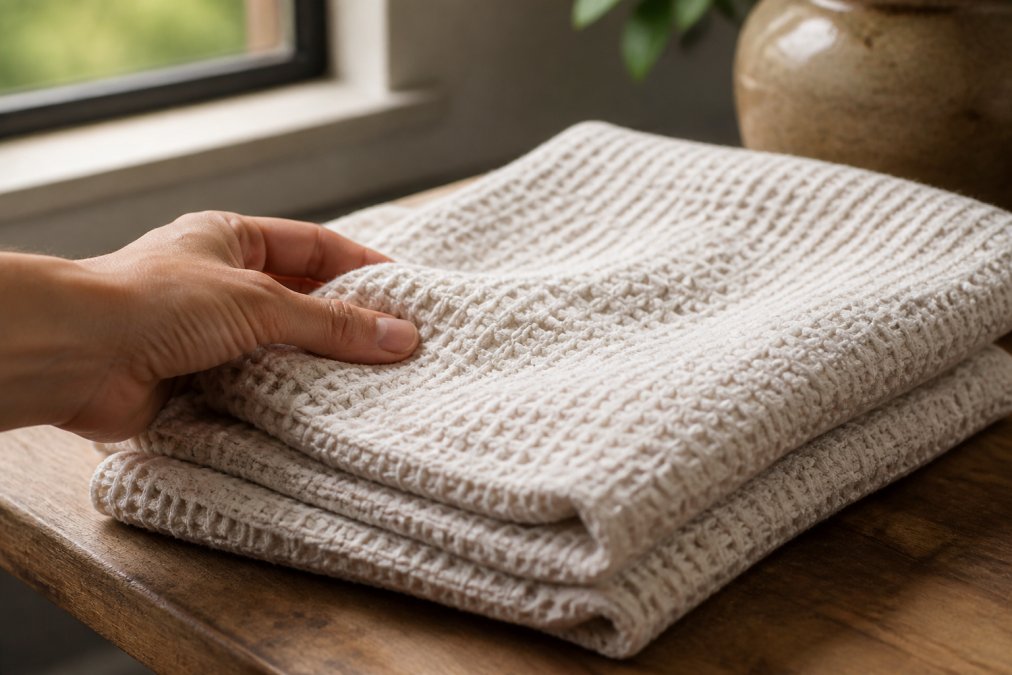
Begin with textiles by rubbing the fabric between your fingers. High-quality weaves feel dense and substantial, while cheap materials often feel thin or slippery. Stretch the fabric gently to check recovery; quality textiles spring back to shape, while lower-grade materials retain creases or sag.
For hard surfaces, run your fingernail across the finish. Quality glaze and sealants resist scratching, while inferior coatings mark easily. Tap ceramics to assess density, and lift pieces to evaluate whether their weight matches their size. As noted in the American Society of Interior Designers' resource on material selection, tactile evaluation remains one of the most reliable methods for assessing product quality before purchase.
Common Mistakes to Avoid When Shopping for Decor
Most shopping errors happen before you ever touch the product, but the most expensive ones happen when you skip physical inspection. Here are the specific mistakes that lead to premature replacement, along with the tactile checks that catch them.
Mistake 1: Trusting Weight Alone
Heavy does not always mean well made. Some manufacturers add metal weights or resin fillers to hollow ceramic bases to simulate density. Instead of judging by heft alone, perform the balance test: place the piece on a perfectly flat surface and press gently on each side. A properly constructed item should not rock or tip. Then tap the body with your knuckle, a clear ring indicates uniform wall thickness, while a dull thud suggests inconsistent clay distribution or internal voids.
Mistake 2: Ignoring Seam Lines and Mold Marks
Mass-produced accessories reveal their origins through visible seam lines where mold halves met. Run your fingertip along edges, corners, and curved surfaces. A raised ridge or slight lip indicates factory molding. Hand-finished pieces will show either no seam at all or subtle, irregular tool marks. On ceramic items, check the foot rim, machine-made pieces often have a sharp, perfectly circular foot, while hand-thrown pieces show a trimmed, slightly irregular base.
Mistake 3: Confusing Patina with Defect
Natural materials age, that is their value proposition. But there is a difference between the warm ambering of solid brass and the flaking of plated zinc. Scratch test inconspicuous areas with a fingernail: solid metal will show a consistent color beneath the surface, while plated metal reveals a different base color. For wood, press your thumbnail into an unseen area. Solid hardwood resists indentation; veneer over particleboard will dent or crush.
Mistake 4: Overlooking Fastener Quality
For any accessory with moving parts or structural connections, the fasteners tell the real story. Remove a drawer or open a hinge and look at the screws. Phillips-head screws driven at an angle suggest rushed assembly; stripped heads indicate soft, low-grade metal. Quality manufacturers use cam locks, dowels, or dovetail joints, not staples or hot glue. Check whether screws are hidden or exposed; exposed hardware should be solid brass or stainless steel, not painted steel that will rust within months.
Mistake 5: Skipping the Stress Test
Retail environments discourage rough handling, but a well made accessory should survive reasonable stress. Gently twist a candlestick holder at its base, it should not flex. Open and close a storage bin lid twenty times; hinges should remain smooth without loosening. Lift a ceramic vase by its rim, the rim should not flex or creak. These micro-stress tests take thirty seconds and reveal structural weaknesses that visual inspection misses.
The One-Week Return Test
A practical strategy used by interior designers is the one-week return test: purchase the piece, bring it home, and live with it for seven days. Does it wobble on your table? Does the finish react to your cleaning products? Does the texture feel different in your lighting than it did in the store? This trial period reveals real-world performance that showroom lighting and styling cannot. Most retailers offer return windows that accommodate this evaluation, use them deliberately rather than relying on impulse judgment.
Build a Collection That Lasts: Final Thoughts
Building a collection of well made home accessories rewards patience and discernment. Each piece you select should earn its place through material quality, thoughtful construction, and genuine utility. As the American Craft Council's guide to collecting suggests, purchasing fewer, better-made items creates homes that feel both intentional and deeply personal.
Start by identifying the pieces you use daily, then invest in the best versions you can afford. A quality vase for fresh flowers, towels that feel luxurious against the skin, and storage that maintains its structure transform everyday routines into rituals. These items support your life rather than demanding constant replacement.
At Castellanos Housing, we curate our collection around these principles, selecting pieces that combine sustainable materials with genuine craftsmanship. Whether you are rewarding yourself or selecting a gift, our products are designed to be kept and used, not displayed and discarded.
Frequently Asked Questions
What are the hallmarks of high-quality home decor?
Look for material integrity first. Solid wood, natural stone, and dense textiles like Australian cotton signal durability. Consistent finish, even glaze on ceramics, and tight, uniform stitching are also signs of well made home accessories. The piece should feel balanced and substantial in your hand, not hollow or flimsy. Check that hardware is secured firmly and moves smoothly. These markers indicate the maker prioritized longevity over speed.
How can you tell if a home accessory is built to last?
Inspect the construction details. For ceramics, check that the glaze is even and the base is ground flat. For textiles, pull gently at the seams and look for dense weaving without loose threads. Ask about the maker and their process. Artisan-made pieces often have subtle variations that confirm a human hand, while mass production shows uniform perfection. Sustainable home decor for 2026 focuses on materials like organic cotton and recycled metals that age well.
What materials indicate superior craftsmanship in home goods?
Natural, unprocessed materials are a strong indicator. Look for 100% cotton with a high thread count, solid hardwoods like oak or walnut, and metals with weight like brass or iron. For ceramics, porcelain fired at high temperatures is more durable than earthenware. These materials develop a desirable patina over time. They are also more likely to be repairable, which aligns with sustainable home decor for 2026 principles.
How do you distinguish between mass-produced and artisan-made decor?
Signs of artisan craftsmanship include subtle irregularities in shape or glaze that mass production removes. Look for visible maker's marks, hand-applied finishes, and joinery that shows care. Mass-produced items often have uniform plastic parts, visible mold lines, and a lighter feel. Ask the retailer about the maker. At Castellanos Housing, we offer a curated selection of items.
The challenge of building a quality home lies in resisting the constant pull toward disposable decor. Every purchase offers a choice between immediate gratification and lasting value. Castellanos Housing makes that choice easier with a curated selection focused on good design that is felt in how a space supports your life, from handmade porcelain vases to Australian cotton textiles. Continue shopping and invest in pieces your home will thank you for.
