

What Is Curated Interior Design? Explained Simply
Table of Contents
- What Curated Interior Design Actually Means
- The Core Principles of a Curated Home
- How to Curate Home Decor: A Repeatable Framework
- Curated Home Aesthetic Examples, Room by Room
- Sustainable Home Decor for 2026: Sourcing with Intention
- Mixing Old and New: Vintage, Antique, and Modern Pieces
- Conclusion: Start Curating with One Thoughtful Choice
- Frequently Asked Questions
Last Updated: October 5, 2026
What Curated Interior Design Actually Means
Curated interior design is the practice of selecting and arranging furniture, art, and decorative objects with deliberate intent, so each piece earns its place and the room tells a coherent story, choosing better, not buying more.
At Castellanos Housing, curation is the difference between a furnished room and a considered one: the considered room has nothing it doesn't.
The word "curated" comes from museums: a curator selects, edits, and arranges so the viewer understands something. Your living room works the same way.
Intentional Design vs. Ordinary Decorating
Ordinary decorating starts with a trend, a sale, or an empty corner. Intentional design starts with a question: what do we actually do in this room, and how should it feel?
Trend-driven shopping produces pieces that were each fine alone but never speak to each other; intentional design produces fewer pieces that share a palette, material language, or mood.
The common mistake is treating them as the same process. Decorating fills space; curation assigns meaning.
The Core Principles of a Curated Home
Three principles do most of the work: visual cohesion, correct scale and proportion, and a personal narrative. Get these right and the room reads as intentional even while unfinished.
Visual Cohesion, Scale, and Proportion
Visual cohesion means a consistent palette, a limited set of materials, and a repeating rhythm of shapes, not matching.
Scale and proportion decide whether a room feels calm or crowded: a large sofa overwhelms a small room, a tiny vase disappears on a long console.
Texture carries cohesion further than color: layering linen, wool, stone, and glass gives the eye somewhere to rest without visual noise.
Personal Narrative and Meaningful Objects
A curated home has a point of view, and it comes from you.
Most guides say "add personality" without explaining how. In practice, personality enters through display: group meaningful objects together, give them space, and let them be seen rather than scattered.
Meaningful objects also solve a design problem: when a shelf holds things you care about, you stop filling it with things you don't.
How to Curate Home Decor: A Repeatable Framework
Learning how to curate home decor is easier with a repeatable process than a mood board. This framework works for a single shelf or an entire room, and you can run it in an afternoon.
- Audit what you own. Pull everything out of the space and sort into keep, repair, and release.
- Define the room's job. Write one sentence describing how the room should feel and what happens there.
- Set a palette and material list. Choose three colors and no more than three materials.
- Choose one focal point. Decide what the eye should land on first: art, a view, a lamp, a vase.
- Place the largest pieces first. Anchor the room, then work inward.
- Layer texture and light. Add throws, rugs, and lamps to soften hard edges.
- Edit. Remove one object from every surface. Then look again.
- Live with it for two weeks before buying anything new.
Step seven is the one people skip, editing separates a collected look from a cluttered one.
The Five-Question Decision Filter
Before any purchase, run it through five questions. If two or more answers are no, leave it in the store.
- Does it fit the palette and materials I already committed to?
- Is the scale right for the exact spot it will live in?
- Does it do something, or is it purely decorative filler?
The Cleveland Museum of Art's guide to curatorial practice explains how professional curators select and arrange objects, and the same logic applies at home: selection matters more than quantity.
Budgeting and Sourcing at Different Price Points
Most guides skip the money conversation. Curation gets easier when you decide, in advance, where to spend and where to save.
A workable split for one room:
- About half of the budget on the anchor piece, the sofa, bed, dining table, or rug. This is the item you touch daily and the one that sets scale for everything else.
- About a third on mid-tier supporting pieces, lighting, side tables, shelving, window treatments. These carry the material story.
- The remainder on accessories and art, vases, candles, textiles, prints. This is where secondhand and handmade shine.
Sourcing channels, ranked by cost per unit of character:
- Estate sales and consignment shops, best for solid wood, brass, and framed art. Inspect joints, drawers, and hardware before buying.
- Thrift and charity stores, best for ceramics, glassware, books, and picture frames. Go weekly; inventory turns fast.
- Online marketplaces for used goods, best for larger furniture when you can inspect in person. Measure doorways and stairwells before you commit.
- Small-batch and handmade makers, best for the one or two pieces you want to keep for a decade.
- Mass retail, best for basics where durability matters more than story: lamp cords, storage baskets, curtain rods.
A simple rule: spend on what you touch and look at daily; save on what sits on a shelf. A handmade porcelain vase kept ten years costs less per year than three trend pieces you replace.

Small-Space and Rental-Friendly Curation
Curation is not a square-footage contest. In a studio, rental, or shared apartment, the same principles apply with a few adjustments.
- Choose furniture that does two jobs. A storage ottoman, a bench with a shelf underneath, a console that doubles as a desk.
- Go vertical. Wall-mounted shelves, a tall narrow bookcase, and art hung higher than you would in a larger room all add presence without eating floor area.
- Use removable, damage-free solutions. Adhesive hooks, tension rods, peel-and-stick wallpaper, and freestanding wardrobes let you curate without losing a security deposit.
Accessibility, Safety, and Everyday Usability
A curated room still has to work. Before finalizing a layout, walk the space and check the practical side.
- Circulation. Leave at least 30 to 36 inches of clear path through main walkways and around the dining table so people can pass comfortably, including anyone using a walker or wheelchair.
- Reach. Keep everyday items between roughly knee and shoulder height. Reserve high shelves for display, not for the things you use daily.
- Stability. Anchor tall bookcases and dressers to the wall, especially in homes with children or pets (CPSC Anchor It! Campaign Marks 10 Years).
Curated Home Aesthetic Examples, Room by Room
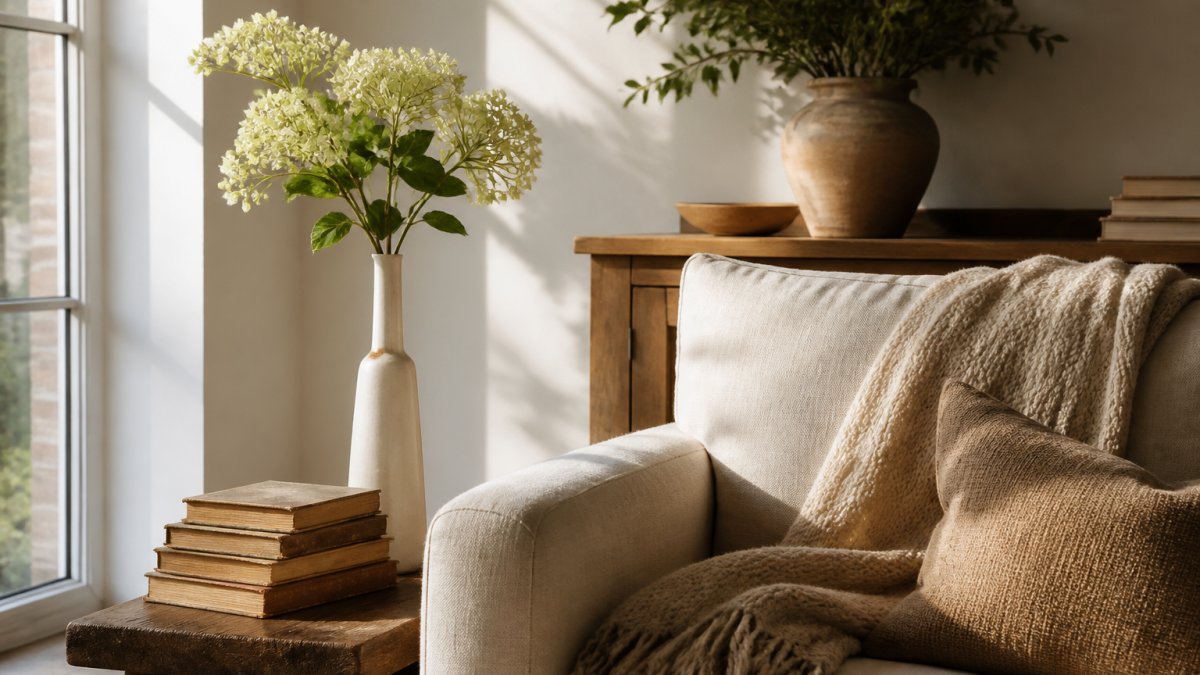
A curated home aesthetic looks different in every room because each room has a different job. The unifying thread is restraint, repeated materials, and one clear focal point per space.
Living Room, Bedroom, and Entryway Curation
In the living room, start with the largest piece of seating and build outward. A single Bloom Vase - Handmade Porcelain Flower Vase with one bouquet will do more for a console than a cluster of small tchotchkes.
Bloom Vase - Handmade Porcelain Flower Vase →
Bedrooms reward softness over statement. Scent belongs here too, and a Handmade Decorative Scented Soy Candle in a simple glass cup adds warmth without visual clutter.

Entryways are the smallest canvas and the easiest to overwork. A tray for keys, [one Angel Candlestick Holder](https://castellanoshousing.shop/products/angel-candle-holder), and a mirror is usually enough. If you want wall presence, a Monochrome Angel Oak Tree Canvas Wall Art gives you a focal point that reads calm rather than busy.

Kitchen, Bathroom, and Home Office Curation
Kitchens are working rooms, so curation here means clearing counters and repeating one material across the visible surfaces.
Bathrooms benefit from the same restraint at a smaller scale. Match the metal finish on faucet, towel bar, and hooks. Roll towels rather than stacking them.
Home offices have a functional focal point already: the screen. Curate around it. Position the desk so the background behind you is intentional on video calls, a shelf, a print, or a clean wall rather than a pile of laundry.
| Room | Focal Point | Keep Surfaces To | Material Focus |
|---|---|---|---|
| Living room | Art or view | 3 objects | Linen, wood, stone |
| Bedroom | Art above bed | 2 objects | Wool, linen, glass |
| Entryway | Mirror | 2 objects | Metal, ceramic, wood |
| Kitchen | Open shelf or bowl | 3 objects | Wood, ceramic, glass |
| Bathroom | Mirror or framed print | 3 objects | Metal, ceramic, linen |
| Home office | Screen backdrop | 3 objects | Wood, metal, textile |
Before and After: What Curation Actually Changes
A before-and-after makes the method concrete. Picture a living room furnished over several years without a plan.
Before:
- A sectional, a recliner, and two accent chairs in four different upholstery colors.
- A gallery wall of fourteen small frames in mixed finishes.
- Six objects on the coffee table, three on each end table, and a shelf of miscellaneous decor.
After applying the framework:
- Two of the four seating pieces are removed or relocated; the remaining pieces share a neutral upholstery and one accent color.
- The gallery wall is edited to five frames in matching or intentionally paired finishes, hung as a single composition.
- Coffee table holds three objects; end tables hold one each; the shelf is grouped into two vignettes instead of scattered items.
The measurable difference is not square footage or budget, it is the number of decisions the eye has to make. Fewer colors, materials, and objects, plus one clear focal point per room, is what reads as curated, and it is repeatable in any home.
Sustainable Home Decor for 2026: Sourcing with Intention
Sustainable home decor in 2026 comes down to buying less, buying better, and knowing where a piece came from.
Sourcing with intention means asking three things before checkout: who made it, what it is made of, and how long it will last.
Price is not value.
U.S. Environmental Protection Agency guidance on reducing household waste outlines how buying durable goods and repairing rather than replacing reduces what households send to landfill.
Mixing Old and New: Vintage, Antique, and Modern Pieces
Mixing old and new works when the two share a color, a material, or a line. Contrast without a common thread looks accidental; contrast with one looks curated.
Layering makes the mix feel intentional: put a vintage brass candlestick beside a contemporary ceramic bowl, and repeat one material across both so the eye connects them.
What most guides miss is that age is not the goal, character is.
Conclusion: Start Curating with One Thoughtful Choice
The hardest part of curation is not design knowledge but resisting the urge to fill a space all at once. Rooms that feel collected are built over years, one considered decision at a time.
That is the work we do at Castellanos Housing. Our collection focuses on details that make everyday life feel supported: a handmade porcelain vase, a scented soy candle poured for a quiet evening, an angel figurine that earns its place on a shelf.
Start with one object you genuinely love, place it where you will see it daily, and build outward. Continue shopping with Castellanos Housing and let one thoughtful choice set the tone for the room.
Frequently Asked Questions
What is the difference between a styled home and a curated home?
A styled home follows trends and looks finished for photos, while a curated home reflects intentional choices made over time. Curated interior design prioritizes meaningful objects, personal narrative, and daily livability over matching sets. You might display a handmade porcelain vase from a trip next to a vintage find, because both tell your story. Styling can be temporary; curation is a slow, ongoing practice that builds character and warmth.
How do I start curating my interior design style if I have no idea where to begin?
Start with one room and one question: how do you want to feel there? Then choose three anchor pieces that support that feeling, such as a comfortable chair, a piece of artwork, or a scented soy candle that signals calm. Build outward with carefully selected pieces that share a color palette or texture. The goal is not to fill space quickly but to make intentional choices you can live with for years.
Does curated interior design have to be expensive?
No. Curated interior design is about thoughtful selection, not price tags. A $15 handmade scented soy candle or a $10 angel candlestick holder can anchor a vignette just as well as a designer piece. Mixing affordable finds with one or two investment items, like a $69.99 canvas wall art, creates a collected look. Budget-conscious curation means buying less but choosing pieces that genuinely fit your home and daily rituals.
What role does sustainability play in curated interior design?
Sustainability fits naturally into curation because both value longevity over disposability. Choosing sustainable home decor for 2026 means favoring materials like porcelain, soy wax, and quality canvas that last, and sourcing from makers who prioritize craftsmanship. When you select pieces you will keep for years, you reduce waste and build a home that feels authentic. Look for items that are dishwasher safe, refillable, or made in the USA to extend their life.
How can I make my home look curated on a budget?
Edit before you add. Remove anything that does not serve a purpose or bring you joy, then group remaining items by color, texture, or theme. Shop secondhand for vintage and antique pieces, and invest in a few new items with strong craftsmanship. A single well-placed piece, like a monochrome oak tree canvas, can elevate a whole wall. Rotate accessories seasonally instead of buying more, and let empty space breathe.
What are the core principles of curated interior design?
The core principles are intentionality, cohesion, and personal meaning. Intentionality means every object earns its place. Cohesion comes from repeating a color palette, material, or scale so the eye moves easily. Personal meaning ties the space to your history through collected objects. Balance beauty with function by choosing pieces you actually use, like a candle holder that fits your evening ritual. These principles keep a curated home from feeling like a showroom.
